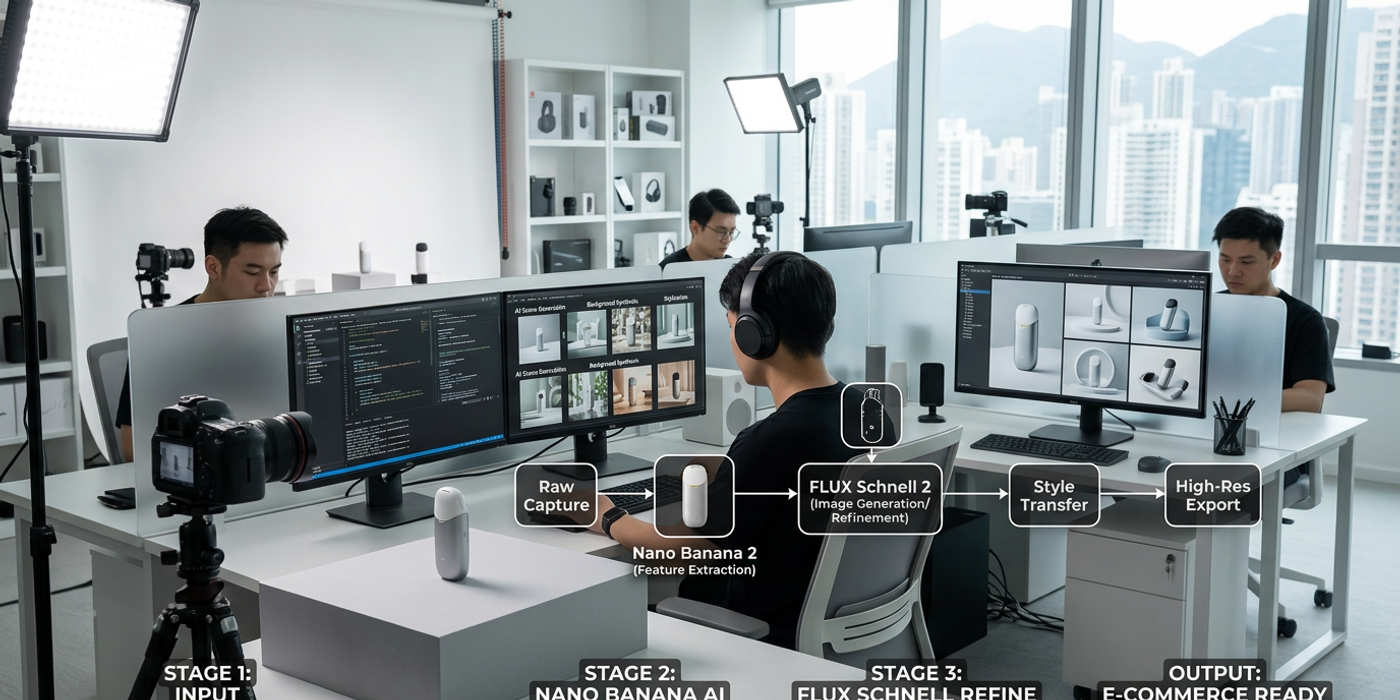
How HK brands automate product photography, catalog images, and social media creatives using late-2026 AI pipelines — from Nano Banana 2 to ChatGPT Images 2.5.
Hong Kong e-commerce brands in 2026 face a content demand that no single photographer or design team can keep up with. Product catalogs refresh weekly, social media needs fresh creatives daily, and marketplaces like HKTVmall and Carousell reward sellers with high-quality visuals. The solution isn't hiring more photographers — it's building an end-to-end AI content pipeline.
A decade ago, producing a single product photo required a studio booking, lighting setup, and retouching session. By early 2026, individual AI models could generate convincing product shots from prompts alone. Today, the shift is toward integrated pipelines — chains of AI models that take a single product input and output photography, catalog images, model try-ons, and social media variants in minutes.
Why Single-Model Workflows Fall Short
Using one AI model for everything is tempting but limiting. A model that excels at product photography — like Nano Banana 2 with its precise brand-color adherence — may not produce the best social media lifestyle shots. Conversely, ChatGPT Images 2.5 handles sketch-to-image workflows well but lacks the consistent output format needed for catalog grids.
Production teams at major HK retailers now run multi-stage pipelines:
- Capture stage: FLUX Schnell 2 for rapid bulk product shots (under 3 seconds per image) - Refine stage: Nano Banana 2 for consistent brand-style rendering and color matching - Context stage: ChatGPT Images 2.5 or Ideogram 4.0 for lifestyle scenes and editorial shots - Scale stage: Batch generation with automated prompt templates for catalog-sized output
This separation of concerns mirrors traditional photography workflows — and the results show it.
Building a Pipeline for Product Photography
The most immediate ROI for HK e-commerce brands comes from automating product photography. Here is a production-tested workflow:
1. Shoot a single reference image of each product against a clean background. This is the only manual step, and it takes a few minutes per product using a phone camera and a lightbox.
2. Generate product variants with FLUX Schnell 2. Point the model at your reference image with prompt templates. One product can generate white-background catalog shots, angled views, and detail close-ups in under 10 seconds total.
3. Apply brand styling with Nano Banana 2. Pass best-in-class outputs through Nano Banana 2 with your brand color palette and lighting preferences. The model maintains compositional structure while applying your visual identity — a capability that sets it apart from earlier models.
4. Add lifestyle context with ChatGPT Images 2.5. For hero images and social media posts, use the sketch-to-image feature to compose products into lifestyle scenes. This is where pipeline thinking pays off: the sketch layer lets you control composition while the model handles textures and lighting.
One Hong Kong apparel brand running this pipeline reports reducing per-product image costs by 85% while increasing catalog image volume from 50 to 1,200 SKUs per month.
Model Try-On and Variant Generation
Traditional model photography is the biggest bottleneck in fashion e-commerce. Coordinating with models, makeup artists, and studios for each collection cycle is expensive and slow. AI model try-on has matured significantly in late 2026.
The pipeline approach works here too:
- Garment segmentation: Separate the product from the background using an automated mask - Virtual try-on: Apply the garment image to a base model photo using specialized try-on models now available through ComfyUI workflows - Pose variation: Generate multiple poses from a single try-on result using pose-conditioned image generation - Background swap: Replace studio backgrounds with lifestyle environments matching your brand aesthetic
This pipeline turns one garment photo into 50+ lifestyle model images in under 30 minutes. The key insight: each stage uses a different optimized model, and the output quality exceeds what a single all-in-one model produces.
Social Media Content at Scale
After product photography and catalog images are automated, the same pipeline feeds social media content. The principle is simple: generate once, repurpose everywhere.
Take a product hero image from your pipeline and run it through specialized generators:
- Square format for Instagram: Cropped and recomposed using prompt-constrained generation - Vertical for Reels and TikTok: Animated with motion brushes or image-to-video models - Carousel for multi-product posts: Automated layout generation with consistent styling - Bilingual text overlay ready: Leave space for English and Chinese copy in the generation prompt
Brands that run this end-to-end pipeline publish 3x more content per week while reducing per-asset production time from hours to minutes. The competitive advantage compounds: more content means more A/B testing, more seasonal campaigns, and faster response to trends.
Choosing the Right Models for Your Pipeline
Not every HK brand needs the same model stack. Here is a decision framework based on content volume and quality requirements:
- Budget-conscious (under 500 SKUs/month): FLUX Schnell 2 for all stages. It handles product photography and basic lifestyle shots well. Supplement with ChatGPT Images 2.5 for hero images only.
- Mid-volume (500–2,000 SKUs/month): FLUX Schnell 2 for bulk capture + Nano Banana 2 for brand styling + ChatGPT Images 2.5 for hero creatives. This three-stage pipeline balances speed and quality.
- High-volume (2,000+ SKUs/month): Add Ideogram 4.0 for editorial shots and dedicated try-on models for fashion. Consider running parallel pipelines for different product categories.
The cost difference between tiers is significant — the budget tier runs around HK$0.15 per image while the high-volume tier averages HK$0.08 per image due to batch efficiencies and model selection.
Frequently Asked Questions
Q: Do I still need a photographer with AI pipelines? A: You still need one for reference photos and quality control. But one photographer can support what previously required a team of five.
Q: Which AI model is best for HK e-commerce in late 2026? A: No single model wins across all categories. Nano Banana 2 excels at brand consistency, FLUX Schnell 2 at speed, and ChatGPT Images 2.5 at lifestyle scenes. Pipeline architectures use each for its strength.
Q: Can AI handle Cantonese text in product images? A: Current image generation models handle mixed English-Chinese text unevenly. Add text overlays in post-production for reliable bilingual output. The pipeline outputs image assets, and text is added at the final layout stage.
Q: How long does it take to set up an AI content pipeline? A: Initial setup takes 2–3 weeks including model selection, prompt template creation, and quality benchmarks. After setup, each new product takes under 5 minutes of pipeline time.
Q: Are there compliance issues with AI-generated product images in Hong Kong? A: The Hong Kong Consumer Council requires accurate product representation. AI images must match the actual product. Pipeline quality checks comparing generated images to reference photos address this.
Q: What is the monthly cost for an AI e-commerce pipeline? A: For a mid-volume brand (1,000 SKUs/month), costs range from HK$800–1,800 including API credits and compute time. This compares to HK$30,000+ for traditional studio photography.
Q: Can I use one model for the entire pipeline? A: You can, but quality suffers. Specialized models outperform generalists at each stage. The small added complexity of a multi-model pipeline pays back in output quality and consistency.
Q: How do I ensure brand consistency across thousands of AI-generated images? A: Use a brand reference image and color palette as inputs to Nano Banana 2 for the refinement stage. Store brand parameters as reusable templates so every pipeline run uses the same settings.