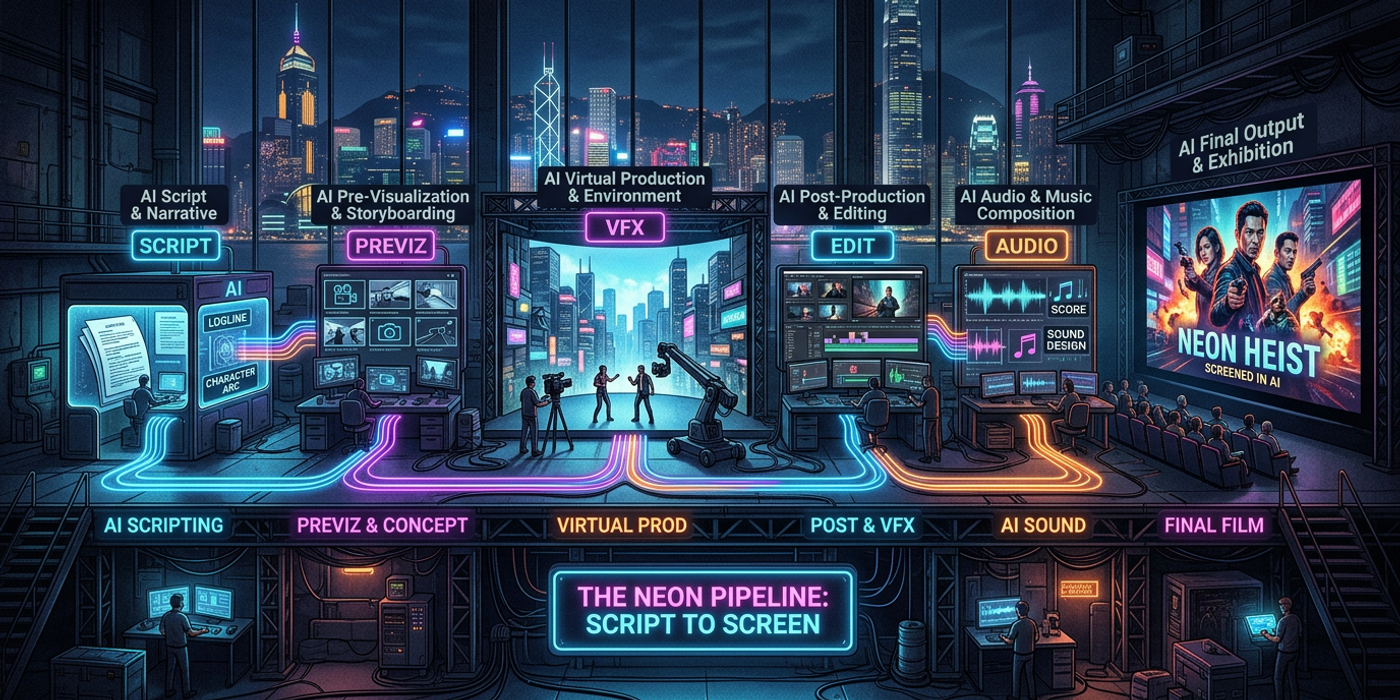
From pre-vis to final export: how HK film studios are chaining 4+ AI models into end-to-end production workflows in late 2026.
The biggest shift in Hong Kong's film production this year isn't a single AI model — it's how studios are connecting multiple models into end-to-end pipelines. From script analysis to storyboard, pre-vis to final render, audio to colour grade, production houses are chaining AI tools together like never before.
From Single-Tool Workflows to Multi-Model Pipelines
Six months ago, most HK production houses treated AI as a one-off tool: generate a storyboard with Midjourney, or upscale a clip with Topaz. Today, the leading studios are building pipelines that pass output from one model to the next. A typical workflow looks like this:
Script → Storyboard (GPT-Image-2 / FLUX Schnell) → Pre-vis animation (Veo 3.1 / Kling 3.0) → Final render (LTX-2.5 / Seedance 2.5) → Audio post (Cartesia / Gradium / Lyria 3.5) → Colour grade (Runway Gen-4)
Each stage feeds the next. The storyboard frames become the style reference for pre-vis animation. The pre-vis clips provide the motion baseline for the final render. The final video's audio track is generated from the original script using TTS or music models.
This pipeline approach has multiple advantages over the single-tool method. First, it reduces the manual rework that happens when you generate everything in isolation. Second, it lets each model do what it does best — specialisation beats generalisation. Third, and most importantly for Hong Kong studios facing tight deadlines, it cuts production time by up to 60% on certain project types.
Pipeline Architecture — Three Patterns Emerging in Hong Kong
Hong Kong's film and advertising production scene has settled on three main pipeline architectures, each suited to a different type of project.
Pattern 1: The Linear Commercial Pipeline
Used for TV commercials, brand videos, and social content where the creative brief is locked early. The pipeline runs in a straight line: script to image generation to video generation to audio to final assembly.
Tools in this stack typically include GPT-Image-2 for keyframe generation, Kling 3.0 or Seedance 2.5 for video, and Gradium or Cartesia for voiceover. Studios report that a 30-second TVC that used to take 2 to 3 weeks can now be turned around in 3 to 5 days using this pattern.
Pattern 2: The Iterative Creative Pipeline
For projects where the creative direction evolves — music videos, experimental shorts, branded content with multiple review rounds. Here, the pipeline loops: generate, review, regenerate specific shots, composite.
This pattern relies heavily on model composability. A studio might generate a scene with LTX-2.5, decide the lighting doesn't match the director's vision, regenerate just that shot with a different prompt, and composite the result without re-rendering the entire sequence. LTX-2.5's multi-shot support makes this practical — you can regenerate individual clips without breaking the continuity.
Pattern 3: The Hybrid Production Pipeline
The most common setup in Hong Kong's mid-size production houses combines AI and traditional VFX. AI handles the heavy lifting of scene generation, character animation, and background plates, while traditional compositing and colour grading handle the finishing touches.
This pattern is particularly popular with studios serving blue-chip clients like HSBC, where brand guidelines demand precise colour matching and specific visual treatments that pure AI pipelines don't yet nail consistently.
Key Models Powering Production Workflows in Late 2026
The pipeline approach only works if the individual models are reliable enough to build around. Several models released since mid-2026 have crossed this threshold.
LTX-2.5 — Open-weight video generation with multi-shot and 4K HDR support. HK studios favour it for final renders because the open-weight architecture lets them fine-tune on their own footage. Multi-shot mode generates up to 60-second clips with consistent characters — a game-changer for dialogue-driven scenes.
FLUX 3 Video — Now generally available with 20-second clips and native audio output. Its strength is motion coherence: characters move naturally across the frame without the warping artefacts common in earlier models. The native audio output means background ambience syncs automatically with the video.
Seedance 2.5 — ByteDance's video model generates video and audio in one pass. For Hong Kong studios producing Cantonese-language content, this eliminates the separate audio syncing step that used to add 3 to 4 hours per project.
Gemini Omni 1.1 Flash — Google's conversational video editing model lets directors edit scenes by describing changes in natural language. A single prompt like "make this scene at dusk instead of noon" replaces a full re-render.
Why Hong Kong Studios Are Leading on Pipeline Adoption
Hong Kong's production industry has structural advantages that make pipeline thinking especially valuable. The city's studios handle a high volume of short-turnaround commercial work for global brands, where speed-to-market is the primary metric. A pipeline that cuts 60% off production time creates real competitive advantage.
Additionally, Hong Kong's bilingual content requirement — most commercial work needs English and Cantonese versions — means audio pipelines with multilingual TTS models like Cartesia Sonic, Gradium, and NVIDIA Magpie are immediately cost-justified. A single voiceover generation step can produce both language versions simultaneously.
Frequently Asked Questions
Q: What is the minimum setup needed to start using an AI production pipeline? A: Start with two models: one image generator for storyboarding (GPT-Image-2 or FLUX Schnell) and one video generator for pre-vis (Kling 3.0 or Veo 3.1). Add audio and final render models as you scale.
Q: How much can a pipeline cut production costs compared to traditional methods? A: Studios report 40 to 60% cost reduction on projects where AI handles scene generation and character animation. Traditional lighting, set design, and VFX compositing remain cost-intensive.
Q: Can you use open-weight models in a production pipeline commercially? A: Yes. LTX-2.5, FLUX 3 Video, and MiniMax models are all open-weight with permissive commercial licenses for production use.
Q: Which pipeline pattern works best for TV commercials? A: The linear commercial pipeline works best for TVCs with a locked brief. For projects requiring multiple client review rounds, the iterative creative pipeline saves more time.
Q: Do you need a technical specialist to set up a pipeline? A: Basic pipelines can be configured by experienced AI operators. Model chaining through API endpoints requires some scripting knowledge, but platforms like ComfyUI and Runway simplify the process.
Q: How reliable are multi-model pipelines for consistent character appearance? A: LTX-2.5 and FLUX 3 Video handle character consistency well within a single model chain. Cross-model consistency still requires careful prompt engineering and reference image management.
Q: What is the biggest risk when chaining multiple AI models together? A: Quality cascading — errors from an early stage like a poorly composed storyboard frame amplify through downstream models. Invest in quality control at each pipeline stage.
Q: How does this affect crew size for Hong Kong production houses? A: Most studios maintain crew size but shift roles toward AI operations, prompt engineering, and pipeline management rather than traditional set-based roles.