Control composition, lighting, and style across GPT-Image-2, FLUX, Nano Banana 2, and Ideogram 4.0. A model-by-model guide for predictable results.
Controlling AI image models requires knowing how each interprets composition, lighting, and style. This guide goes beyond theory: how to control specific models for the exact framing, mood, and look you need.
Different models have different strengths. GPT-Image-2 excels at cinematic lighting but struggles with precise framing. FLUX Schnell delivers fast, stylised results but handles negative prompts in ways other models do not. Nano Banana 2 is exceptional at replicating reference image composition. Understanding these differences saves you time, credits, and frustration.
Why Model-Specific Composition Matters
The 2026 landscape is fragmented across transformer-based models (GPT-Image-2, MAI-Image-2.5), latent diffusion variants (Nano Banana 2, FLUX), and hybrid architectures (Ideogram 4.0, Seedream 4) — each with distinct composition strengths.
Transformer models process images as patch sequences, giving strong global awareness but weaker local control. Diffusion models maintain spatial consistency through latent space operations but struggle with complex multi-subject framing.
For Hong Kong agencies producing brand content, this means you need to tailor your approach to each model rather than expecting a universal prompt formula to work everywhere.
Controlling Composition Across Models
Composition — how subjects are framed and positioned — is where models diverge most noticeably.
GPT-Image-2 responds well to explicit camera framing language — "wide shot, subject centred, negative space on the left" — and understands cinematic terminology with high accuracy. It favours balanced compositions unless prompted for asymmetry.
Nano Banana 2 excels when given a reference image for composition. Its image-to-image pipeline preserves spatial layout almost exactly while altering style or content. For brand consistency, this is the model to use when you need the same product shot in different visual treatments.
FLUX Schnell and FLUX Pro handle composition through negative prompts with surgical precision — "no foreground objects, no cluttered background" — ideal for product photography requiring clean isolation.
Ideogram 4.0 introduced native 2K resolution support, but its composition engine is best at text-heavy layouts. If you need an image with embedded typography that looks intentional rather than pasted in, Ideogram is the strongest choice among current models.
Lighting Control: Cinematic vs. Flat vs. Stylised
Lighting direction, quality, and colour temperature are where prompts most often fail. Each model interprets lighting language differently.
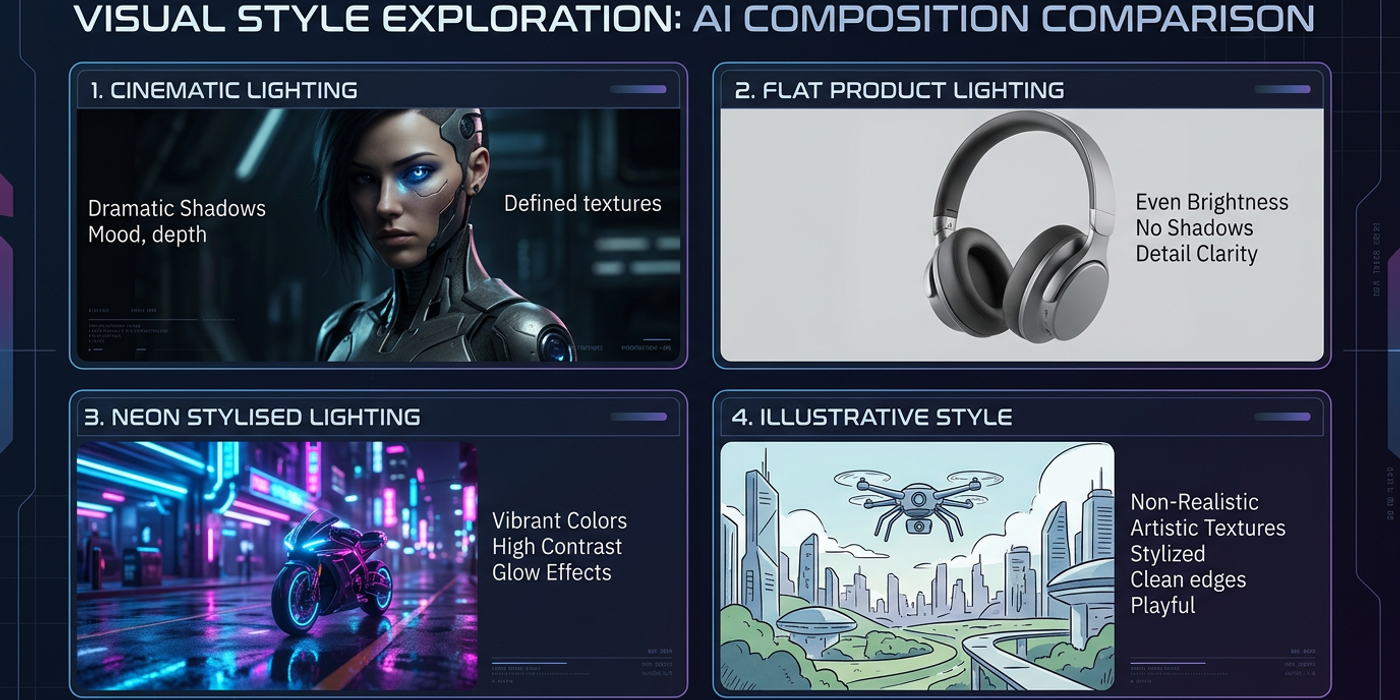
Cinematic lighting: GPT-Image-2 and Seedream 4 produce the most film-like lighting results. Prompts using "key light from camera right, rim light, warm fill, deep shadows" work reliably. GPT-Image-2 in particular understands three-point lighting setups and maintains consistent shadow direction across multiple generations.
Flat/product lighting: Nano Banana 2 and MAI-Image-2.5 excel at even, shadowless lighting suitable for e-commerce. Prompts like "soft diffused lighting, no harsh shadows, even illumination from all sides" produce clean product shots without the dramatic contrast that other models default to.
Stylised/artistic lighting: FLUX Pro handles coloured gels, neon, and practical light sources best. "Moody neon-lit alley, purple and cyan practical lights, wet ground reflections" — FLUX Pro renders the atmosphere without washing out the subject, a problem common in other models.
For Hong Kong creatives shooting products or scenes with mixed indoor-outdoor lighting, the practical tip is to describe the light source rather than just the mood. "Golden hour, sun low behind subject, long shadows" works across models; "warm atmospheric" does not.
Style Transfer and Visual Consistency
Modern models support reference-based styling beyond simple style prompts. Knowing which to use saves significant iteration time.
GPT-Image-2 supports sketch-to-image workflows where a rough composition sketch guides layout while the model interprets style from text. Useful for storyboarding and ad concepting.
MAI-Image-2.5 matches Nano Banana 2 on quality but offers stronger style interpolation — blend a composition reference and a texture reference for unique visual treatments. Valuable for brand-specific visual languages.
Seedream 4 handles painterly and illustrative styles better than photorealistic ones, preserving brush texture and colour palette faithfully.
FLUX maintains style consistency across batch generations better than any competitor — the same prompt with a style reference produces consistent colour palette and lighting across outputs. For agencies producing campaign assets, FLUX is the reliability pick.
How to Choose the Right Model for Your Composition Needs
Start with the image's primary requirement:
- Need precise framing and cinematic lighting? → GPT-Image-2 - Need to preserve layout from a reference image? → Nano Banana 2 - Need clean isolation with negative prompt control? → FLUX Schnell or FLUX Pro - Need embedded text in the image itself? → Ideogram 4.0 - Need consistent batch outputs for a campaign? → FLUX with style reference - Need artistic/illustrative style from reference images? → Seedream 4 - Need to blend two reference styles? → MAI-Image-2.5
Knowing which model to reach for halves iteration time and doubles result predictability.
Frequently Asked Questions
Q: Can I get the same composition across different models? A: Not exactly — each model interprets framing language differently. The closest consistency comes from using reference images and negative prompts together, which works well on Nano Banana 2 and FLUX models.
Q: How do I prompt for specific lighting setups like three-point lighting? A: Use explicit cinematography language specifying angle, intensity, and colour. GPT-Image-2 is the most reliable model for three-point lighting.
Q: Does increasing resolution affect how models handle composition? A: Yes. Higher resolutions reveal composition weaknesses. Always validate at your target output size — a well-composed 1024×1024 may show awkward cropping at higher resolutions.
Q: How many reference images do I need for consistent style? A: One style reference image is enough for most models. Two references — one for composition and one for texture — give stronger results with MAI-Image-2.5 and Nano Banana 2.
Q: Why does my "clean product shot" prompt return busy backgrounds? A: The model lacks explicit negative instructions. Add negative prompt instructions like "white seamless background, no props, no text." FLUX handles this best among current models.
Q: Can Hong Kong small businesses use these techniques without a design team? A: Yes. Tools like Cooly.ai abstract model selection so you can specify the look you want — cinematic, product, illustrative — without learning each model's prompt syntax. The platform handles the model routing.
Q: Which model produces the most consistent brand colour reproduction? A: FLUX with a style reference image delivers the most consistent colour palette across batches. Seedream 4 is stronger for illustrative palettes, while GPT-Image-2 is better for photographic colour reproduction.