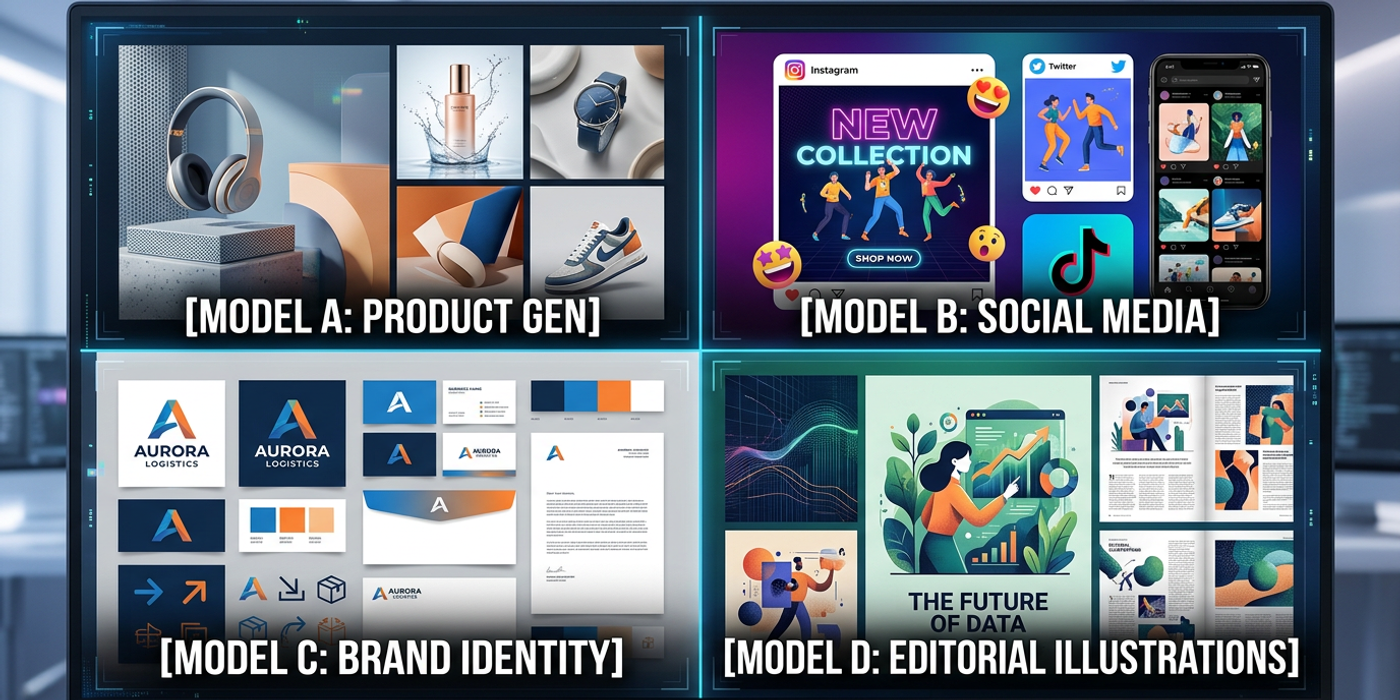
Different AI image models excel at different creative tasks. Learn which model and prompt strategy works best for your project in late 2026.
Different AI image models excel at different creative tasks. A prompting strategy that produces stunning e-commerce product shots may fall flat for social media content — and what works for brand identity assets won't necessarily translate to editorial-quality concept art. As the AI image generation landscape grows more fragmented with every update, the winning approach is to match the model and prompt strategy to your specific use case.
In late 2026, creators in Hong Kong and beyond have an embarrassment of choices: GPT-Image-2 for photorealism, FLUX Schnell for speed, Nano Banana 2 for stylistic consistency, Stable Diffusion 4.0 for open-weight flexibility, Seedream 4 for East Asian aesthetics, and Ideogram 4.0 for text rendering. Each model brings distinct strengths — and knowing which one to reach for saves both time and credits.
Here is a use-case-driven guide to AI image generation in late 2026.
E-Commerce Product Photography: Consistency at Scale
For Hong Kong e-commerce brands — from fashion retailers on Shopline to cross-border sellers on Taobao — product photography represents the highest-volume image generation need. The requirements are demanding: consistent lighting across dozens of SKUs, accurate product proportions, clean backgrounds for listing images, and the ability to iterate on variations quickly.
Nano Banana 2 remains the top choice for product photography due to its exceptional style consistency across generations. Its style-lock feature lets you feed one reference image and maintain identical lighting, colour temperature, and composition across an entire product line. This is invaluable for brands that need 50+ product images in a single campaign.
The key to great product shots with Nano Banana 2 is specificity in your brief. Instead of "a white sneaker on a marble surface," try: "white leather sneaker with three eyelets, side profile, on polished white marble, studio lighting from upper left, soft shadows, 85mm lens, shallow depth of field." The model rewards detailed spatial descriptions.
For speed, FLUX Schnell can generate usable e-commerce images in under three seconds — ideal for rapid A/B testing of product angles before committing to full production renders with Nano Banana 2. Use FLUX Schnell for drafts, then escalate to a higher-fidelity model for final assets.
Social Media Content: Speed and Variety
Social media demands volume, variety, and fast turnaround — the opposite of e-commerce consistency. A Hong Kong brand might need a carousel for Instagram Stories, a promotional graphic for Facebook, and a short video thumbnail for YouTube Shorts, all in one morning.
GPT-Image-2 excels here because of its native understanding of composition and layout. It handles text-integrated designs well, producing social graphics that need minimal post-processing. For Instagram carousels, prompting GPT-Image-2 with "three-panel Instagram carousel, pastel colour palette, HK skyline silhouette, minimalist" often produces publication-ready results in a single pass.
FLUX Schnell is the workhorse for rapid iteration. When you need to generate 20 variations of a social graphic and pick the best five, FLUX Schnell's speed makes batch generation practical. Prompt with composition constraints first, then refine with more specific styling details after selecting the best candidates.
For video-first platforms, consider pairing image generation with a video model. Generate keyframe images with GPT-Image-2, then animate them through Kling or Veo 3.1. This hybrid workflow produces higher-quality results than text-to-video alone.
Brand Assets: Identity and Control
Brand identity assets — logos, colour palette explorations, brand guidelines illustrations, and campaign visuals — require the highest degree of control. This is where Seedream 4 and Ideogram 4.0 shine.
Seedream 4, developed by ByteDance, has an intuitive understanding of East Asian design sensibilities. For Hong Kong brands that blend Eastern and Western aesthetics, it produces compositions that feel culturally appropriate without needing explicit cultural prompting. Its style-transfer capability lets you apply a brand's existing visual identity to new compositions with high fidelity.
Ideogram 4.0 remains unmatched for text rendering in images. If your brand assets include typography as a design element — a common need for HK brand guidelines that feature bilingual English and Chinese text — Ideogram 4.0's open-weight release means it can be fine-tuned on your specific brand fonts and colour palette.
For maximum control, Stable Diffusion 4.0 offers the most flexibility through its ecosystem of LoRAs, ControlNet models, and community workflows. If your brand requires very specific visual characteristics — a particular illustration style, a signature texture, or a custom colour science — fine-tuning a Stable Diffusion checkpoint on your brand assets delivers the most consistent results.
Editorial and Concept Art: Maximum Fidelity
When the goal is maximum visual impact — campaign hero images, editorial illustrations, or concept art — the clear choice is GPT-Image-2. Its native understanding of cinematography, lighting, and composition produces images that hold up at full resolution.
What sets GPT-Image-2 apart is its compositional reasoning. When prompted with "a futuristic Wan Chai street scene at night, neon reflections on wet pavement, cinematic anamorphic framing, blue and purple colour palette," it understands the spatial and atmospheric relationships between elements.
For concept art workflows, layering GPT-Image-2 with image-to-video models opens creative possibilities. Generate a high-fidelity keyframe, then animate atmospheric elements — rain, fog, moving light sources — through Kling or Veo 3.1. The result is a short cinematic sequence that retains the compositional quality of the original image.
Frequently Asked Questions
Q: Which AI image model is best for Hong Kong e-commerce product photography? A: Nano Banana 2 leads for consistency across product lines, while FLUX Schnell works well for rapid prototyping and angle testing before final production.
Q: Can I use the same prompt across different models? A: Not effectively. Each model interprets prompting language differently. GPT-Image-2 rewards detailed composition instructions, while Nano Banana 2 performs best with specific product descriptions and fewer stylistic abstractions.
Q: Is Ideogram 4.0 still the best for text in images? A: Yes, Ideogram 4.0 remains the top choice for accurate text rendering, especially for bilingual English and Chinese typography. Its open-weight model also allows custom fine-tuning for brand-specific fonts.
Q: How do I choose between GPT-Image-2 and Seedream 4 for brand assets? A: Choose GPT-Image-2 for photorealism and cinematic quality, and Seedream 4 for East Asian aesthetics and culturally appropriate compositions — particularly for brands targeting Hong Kong and mainland Chinese audiences.
Q: What is the fastest AI image model for social media content? A: FLUX Schnell generates usable images in under three seconds, making it ideal for high-volume social media content where speed matters more than absolute fidelity.
Q: Can I combine AI image generation with AI video for better content? A: Yes, generating keyframe images with GPT-Image-2 or Nano Banana 2 and then animating them through Kling, Veo 3.1, or Seedance creates higher-quality results than text-to-video alone, especially for campaign hero content.
Q: How many credits do different models consume per image? A: Pricing varies significantly. FLUX Schnell costs roughly one-third the credits of GPT-Image-2 per image. Batch your high-fidelity renders in off-peak hours and use faster models for prototyping to optimise costs.
Q: Which model handles bilingual Chinese and English best? A: Ideogram 4.0 leads for text, and Seedream 4 leads for culturally appropriate bilingual visual compositions. For purely textual bilingual content like brand guidelines, use Ideogram 4.0; for visual campaigns, use Seedream 4.