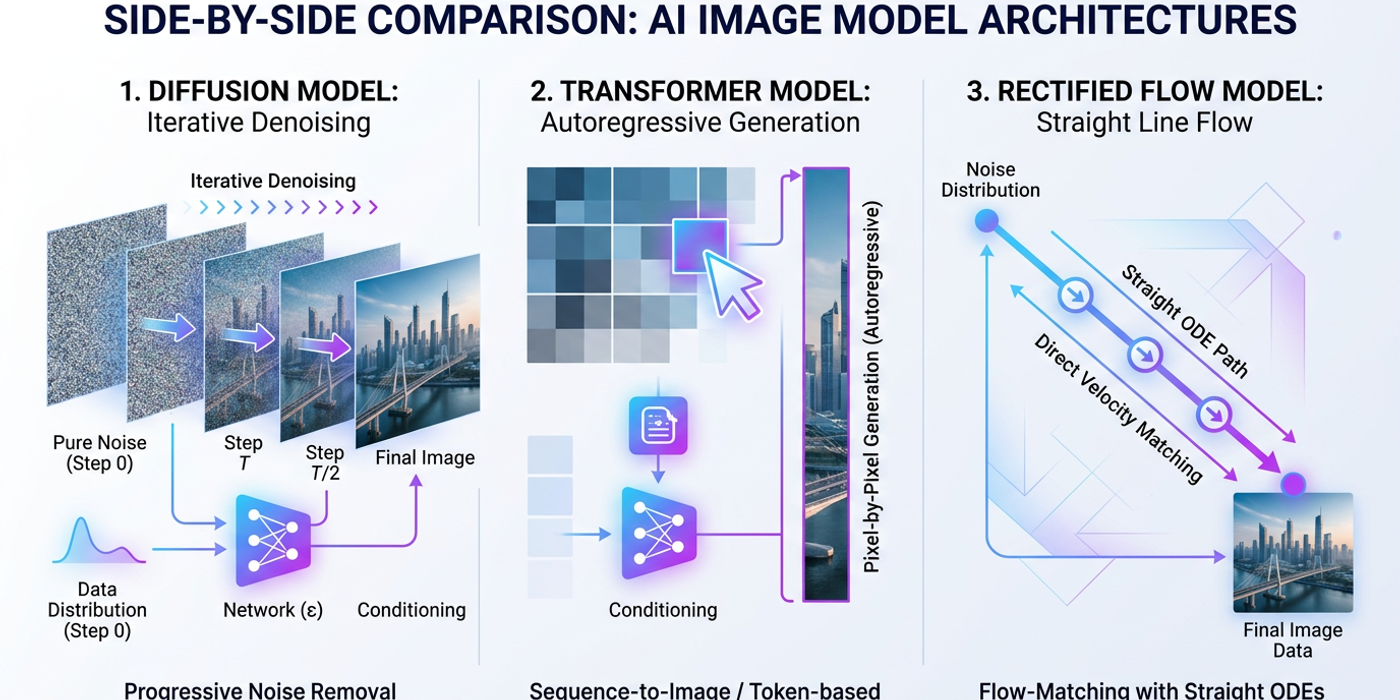
Understand how diffusion, rectified flow, and transformer-based AI image generators work in 2026 — and what each architecture means for your creative output.
Not all AI image models work the same way. While early 2026 models primarily used latent diffusion, the landscape has diversified into rectified flow, autoregressive transformers, and hybrid architectures — each with distinct trade-offs in speed, quality, and control. Here's what Hong Kong creators need to know about how these different architectures actually work and which one suits their workflow.
Diffusion Models: The Original Approach
Diffusion models, pioneered by Stable Diffusion and refined through multiple generations, work by gradually removing noise from random static to produce a coherent image. The model learns the statistical distribution of real training images, then reverses a noise-adding process step by step — guided by your text prompt. Each step moves the image closer to something recognisable.
In 2026, most diffusion models operate in latent space rather than pixel space. This means they compress images into a smaller mathematical representation before denoising, which is significantly faster and more memory-efficient. FLUX Schnell, for example, can generate high-resolution images in just 1-4 steps, while earlier diffusion models required 20-50 steps for comparable quality.
The key innovation driving modern diffusion models is step-aware guidance. Higher guidance forces the output to match your prompt more closely but can introduce artefacts; lower guidance produces more creative variation but risks drifting off-prompt. Models like Stable Diffusion 3.5 and FLUX Pro adjust guidance automatically based on the inference budget — a feature that matters less for transformer-based models.
For Hong Kong agencies producing product photography or social media assets, diffusion models remain the workhorse choice because they deliver predictable, high-fidelity textures at a controllable cost.
Rectified Flow: The Speed-First Evolution
Rectified flow models represent a fundamentally different mathematical approach. Instead of following the curved diffusion trajectory, they directly map noise to data along a straight-line path. Black Forest Lab's FLUX family was the first to popularise this formulation at scale, and Seedance 2.5 from ByteDance adopted it for video generation.
The practical advantage is straightforward: fewer inference steps for equivalent quality. A rectified flow model can produce a publication-ready image in 4-8 steps where a classic diffusion model would need 20-30. The trade-off is that each individual step is computationally more expensive — but the net result is still faster overall generation by a significant margin.
For Hong Kong creators producing high-volume social media content or iterating through dozens of variations, this speed difference is transformative. A batch of 16 product shots that takes 3 minutes with a diffusion model might complete in under a minute with rectified flow. During tight campaign deadlines, that margin matters.
The catch? Rectified flow models can exhibit slightly different aesthetic tendencies — often more saturated colours and sharper edges — which may or may not suit your brand guidelines. Testing before committing to a pipeline is recommended.
Transformer-Based Generators: A Semantic Leap
GPT-Image-2, DALL-E 3, Ideogram 4.0, and aspects of Seedream 4 use autoregressive transformer architectures — the same family of models that power large language models like GPT-4 and Claude. Instead of iteratively denoising an image, these models generate images token by token, predicting the next patch or pixel based on the previous ones.
The key differentiator is semantic understanding. Transformer-based generators comprehend complex multi-object prompts — "a red car parked next to a blue bicycle under a cherry blossom tree with a cat sitting on the car roof" — better than diffusion models, which can collapse multiple concepts into visual noise or disregard less prominent objects.
The trade-off is resolution. Autoregressive generation at native 4K is computationally prohibitive, so most transformer models generate at a base resolution (typically 1024×1024), then upscale. GPT-Image-2 uses a separate super-resolution pass, which adds latency but preserves the compositional accuracy that makes transformer models valuable.
For advertising agencies crafting specific visual narratives — a Hong Kong street scene with precise brand elements in prescribed positions — the transformer approach often produces the most faithful results.
Hybrid Architectures: Why the Lines Are Blurring
Several leading 2026 models blur the line between paradigms. Nano Banana 2 uses a diffusion-transformer hybrid: a transformer backbone processes prompt understanding and linguistic relationships, then a diffusion decoder handles pixel-level detail generation. Microsoft MAI Image 2.5 combines rectified flow with cross-modal attention layers for better brand-style adherence.
These hybrids are increasingly popular because they mitigate the weaknesses of each approach. Transformer heads improve prompt adherence and prevent concept bleed, while diffusion decoders maintain the high-frequency detail and texture quality that pure autoregressive models struggle with. The result is consistently higher quality across a wider range of prompts.
For Hong Kong creative teams, hybrid models offer the most versatile single-tool option. A single Nano Banana 2 instance can handle product photography, social media graphics, storyboard concepts, and marketing collateral with fewer prompt adjustments than a pure diffusion or pure transformer model.
Choosing the Right Architecture for Your Workflow
There's no universal best architecture — the right choice depends entirely on your use case:
- Fast iteration (social media, concept boards): Rectified flow (FLUX Schnell, Seedance) for speed - Complex multi-object prompts: Transformer-based (GPT-Image-2, Ideogram 4.0) for comprehension - Brand-consistent production work: Hybrid models (Nano Banana 2, MAI Image 2.5) for reliability - Maximum quality regardless of speed: Diffusion with high step count (Stable Diffusion 3.5, FLUX Pro) - Character consistency across generations: Transformer models with identity preservation (Seedream 4)
For most Hong Kong agency workflows, a two-model pipeline works best: a transformer or hybrid model for concept exploration and prompt refinement, then a rectified flow or diffusion model for high-volume final output. This approach balances the semantic strengths of transformers with the throughput of rectified flow.
Frequently Asked Questions
Q: What's the main difference between diffusion and rectified flow? A: Diffusion models remove noise along a curved path; rectified flow takes a straight-line route, requiring fewer steps for equivalent quality.
Q: Can transformer-based models match diffusion image quality? A: They excel at compositional accuracy but generally require upscaling for high-resolution output. Diffusion models produce finer texture detail at native resolutions.
Q: Which architecture is fastest for batch generation? A: Rectified flow models like FLUX Schnell — they produce quality images in 1-4 steps, making them ideal for high-volume social media production.
Q: Does architecture affect how I write prompts? A: Yes. Diffusion models favour concise, keyword-heavy prompts. Transformer models handle longer, sentence-style descriptions with multiple subject relationships.
Q: What's the most popular architecture for Hong Kong agencies in 2026? A: Rectified flow leads for speed-critical work, while hybrid diffusion-transformer models are the fastest-growing category for production-grade deliverables.
Q: Are hybrids worth the extra computational cost? A: For production work requiring consistent brand adherence, yes. The reduced need for prompt engineering and re-generation often offsets the higher per-generation cost.
Q: What is "concept bleed" and why does it matter? A: Concept bleed is when a diffusion model blends unrelated prompt elements — producing, say, a car-bicycle hybrid instead of two separate objects. Transformer models handle this separation better.
Q: Do newer architectures make older models obsolete? A: Not at all. Classic diffusion models still excel at photorealistic textures and predictable outputs. Each architecture has strengths that make it the best choice for specific tasks.