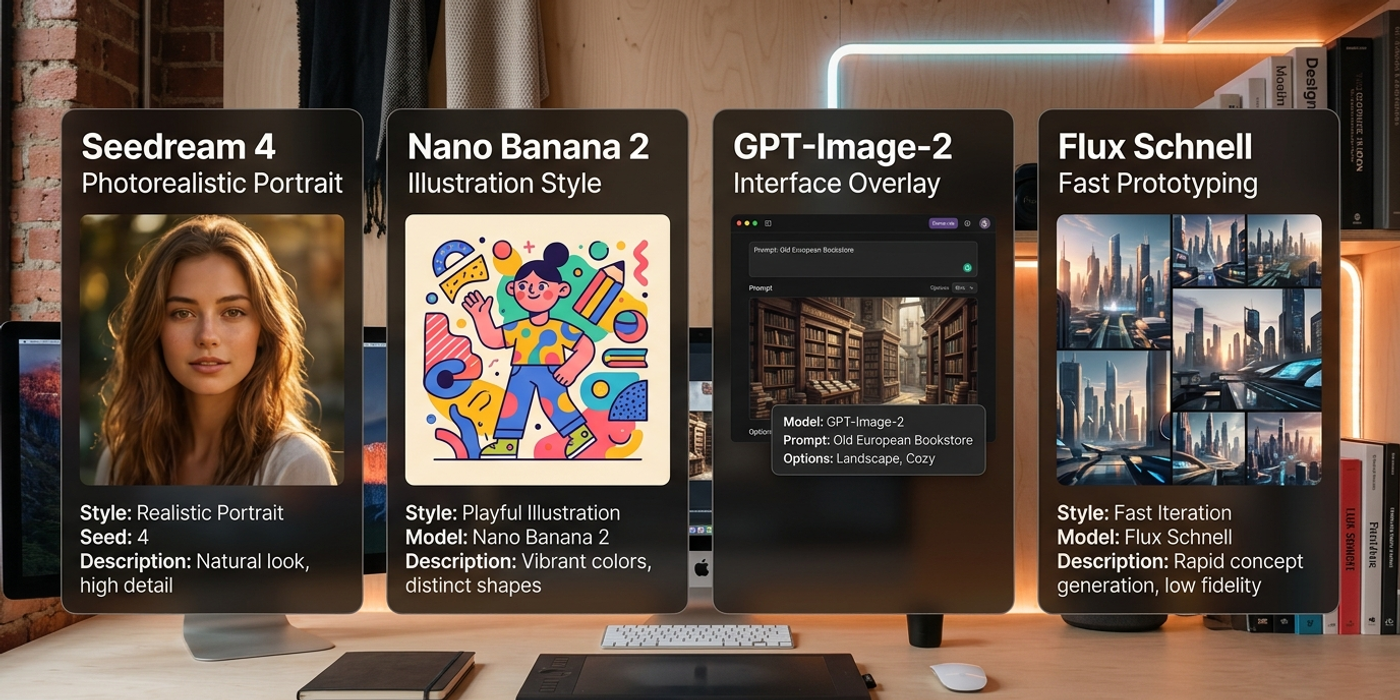
New models like GPT-Image-2 changed AI image generation since mid-2026. Match the right model to your output for professional results every time.
Since May 2026, the AI image generation landscape has shifted significantly. GPT-Image-2 brought conversational editing, Seedream 4 refined its photorealism, and Nano Banana 2 expanded its style range. The original advice from spring still holds for prompt basics, but late 2026 demands a more strategic approach — one that starts with model selection, not prompt tricks.
The New Model Landscape
Several key developments since May changed what is possible with AI image generation:
GPT-Image-2 launched with native multimodal editing — you can upload an image and describe changes in natural language. It understands composition, lighting, and subject placement conversationally, making it the most intuitive model for iterative refinement. Unlike earlier models that required full prompt rewrites for every change, you can now hold a dialogue with your image.
Seedream 4 received significant updates to its photographic realism pipeline. Skin texture, fabric detail, and environmental lighting are noticeably better than the spring release, making it the strongest choice for photorealistic output. Side-by-side comparisons from May versus July show markedly better shadow rendering and natural skin tones.
Nano Banana 2 expanded its style support, now handling art deco, watercolour, and minimalist aesthetics as well as it handles photorealism. This makes it the most versatile option for stylized work, especially for brands that need a distinctive visual identity.
Flux Schnell remains the fastest option for prototyping, though its output quality has been matched by newer lightweight models. It still wins on speed for volume work and rapid iteration.
On Cooly.ai, you can switch between all of these mid-session. The strategic question is no longer which prompt works but which model for which job.
Model Selection by Output Type
Product photography for e-commerce — Seedream 4 leads here. Its photorealism pipeline produces consistent lighting and texture that reads as studio-quality. Pair it with prompts specifying white background, soft studio lighting, centered composition, and shot on 85mm lens. The results match professional product photography without the studio overhead.
Character art and portraits — GPT-Image-2 excels at human subjects because you can iterate conversationally. Generate a face, then say make the lighting warmer or change the expression to a slight smile without rewriting the entire prompt. Seedream 4 is a close second for single-shot portraits when you want photorealism without editing.
Concept art and illustration — Nano Banana 2 handles stylized outputs best. Keywords like art deco, minimalist, or watercolour produce consistent results that match the intended aesthetic. Use Flux Schnell for composition exploration before committing to Nano Banana 2 for the final render.
Social media content — Flux Schnell speed advantage matters here. Generate ten variants in the time other models produce two or three. Use Flux for volume, then pull the best into Seedream 4 or GPT-Image-2 for the final polished version.
Prompt Tactics That Changed
The fundamentals from spring 2026 — layered prompts, artistic vocabulary, negative prompts — still work. But late 2026 adds new tactics that save time and credits.
Conversational iteration with GPT-Image-2: instead of rewriting the full prompt, describe what to change. Make the background more urban or add more contrast to the shadows. The model understands edits as instructions, not new prompts. This cuts per-edit time significantly.
Model-aware vocabulary: each model responds differently to the same terms. Seedream 4 responds well to photographic terms like 35mm or f/1.8. Nano Banana 2 responds better to art terms like watercolour wash or painterly. GPT-Image-2 understands all vocabulary equally well because its multimodal training covered both photography and art captions.
Reference-first prompting: with all models now supporting image references on Cooly.ai, start with a reference image and use the prompt to describe changes rather than building a scene from scratch. This cuts generations from five to eight attempts down to two or three.
Quality Verification in Late 2026
The models are good enough now that most failures are subtle — slightly off anatomy, inconsistent lighting, or unnatural texture. A quick checklist catches most issues: check hands and fingers first, verify lighting direction is consistent across all subjects, confirm texture detail matches the output type, and run at least one variant in a different model to compare. Cooly Studio side-by-side comparison feature makes this fast — load two variants and zoom to check detail at 100 percent magnification.
Frequently Asked Questions
Q: Which AI image model is best in late 2026? A: It depends on your output. Seedream 4 for product photos, GPT-Image-2 for iterative portraits, Nano Banana 2 for illustration, and Flux Schnell for fast prototyping.
Q: Does GPT-Image-2 replace the need for prompt engineering? A: No. Conversational editing is faster for refinements, but strong initial prompts still produce better first results and use fewer credits.
Q: Is Seedream 4 still the best for photorealism? A: Yes, especially after its mid-2026 update. Skin texture and environmental lighting quality improved noticeably over the spring release.
Q: Can I use multiple models in the same project? A: Yes — Cooly.ai lets you switch models mid-session. Start with Flux Schnell for ideation, then switch to Seedream 4 or GPT-Image-2 for the final render.
Q: How do negative prompts work differently now? A: The same way, but GPT-Image-2 lets you add negative instructions conversationally without rewriting the negative prompt field.
Q: What is the biggest change since mid-2026? A: Model diversity. In spring one approach worked across models. Now each model has distinct strengths, and matching the model to the task matters more than prompt complexity.
Q: How many iterations should I expect before a usable result? A: With model-aware strategies and reference images, three to four generations. Without them, eight to ten. The model choice cuts iteration more than any other factor.
Q: Does Cooly.ai support all these models? A: Yes — Seedream 4, Nano Banana 2, Flux Schnell, and GPT-Image-2 are all available in Cooly Studio with drag-and-drop reference images and side-by-side comparison tools.