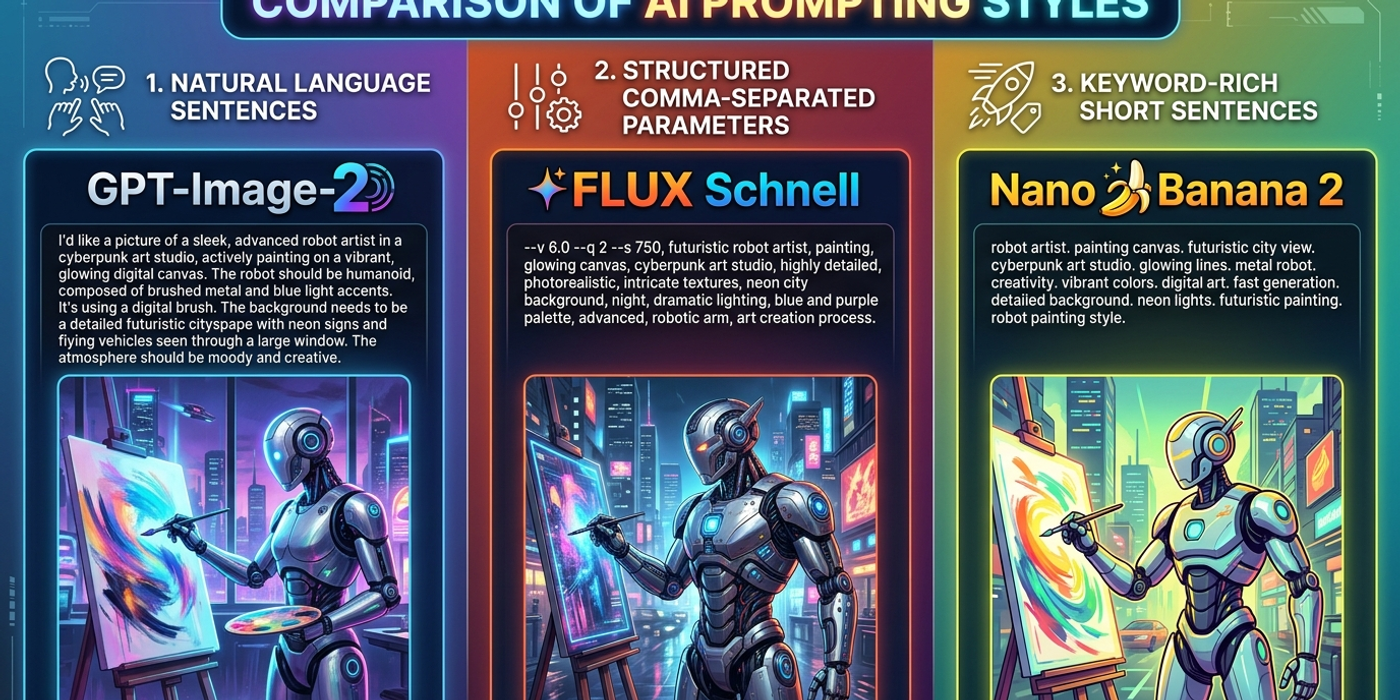
GPT-Image-2 prefers natural language, FLUX Schnell needs structured parameters, Nano Banana 2 runs on keywords. Adapt your style for each model in 2026.
The era of one-size-fits-all AI image prompts is over. In early 2026, most models understood prompts roughly the same way — subject, style, lighting, medium. Today, GPT-Image-2, FLUX Schnell, and Nano Banana 2 each process language differently, and using the wrong prompting style can mean the difference between a publishable image and a miss.
The good news? Once you understand how each model "thinks" about your prompt, you can switch between them in seconds. This guide breaks down the prompting style each model prefers, with real examples you can test on Cooly Studio today.
GPT-Image-2: Natural Language Is the Default
GPT-Image-2 is built on OpenAI's GPT architecture, which means it processes prompts like a conversation rather than a keyword list. This is the most significant shift in AI image prompting since negative prompts became standard.
Write full sentences, not keyword soup. GPT-Image-2 parses subject-verb-object relationships. "A ceramic teapot with a floral pattern sits on a wooden table next to a slice of cake" produces a coherent scene, not four disconnected elements. Contrast this with "teapot floral pattern wooden table cake slice" which would work fine on older models but loses composition coherence on GPT-Image-2.
Use natural modifiers. Instead of "cinematic lighting, volumetric rays," GPT-Image-2 responds better to "The room is lit by a single window on the left, casting long soft shadows across the floor." The model infers cinematic quality from the scene description rather than from a keyword trigger.
Leverage compositional descriptions. GPT-Image-2 understands spatial relationships natively. "A woman in the foreground looks over her shoulder at a distant city skyline where the sun is setting" produces a correct depth-of-field composition without needing "shallow depth of field" as a keyword.
For Hong Kong creators producing brand photography on Cooly Studio, GPT-Image-2 excels when you describe the scene like you would to a human photographer — full sentences, spatial relationships, and natural lighting cues.
FLUX Schnell: Structured Parameters for Precision
FLUX Schnell (from Black Forest Labs) was optimised for speed but demands a more structured approach. It is a diffusion model at heart, and it processes prompts the way Stable Diffusion veterans expect — keyword-dense with clear separators.
Lead with the subject, then layer details. "A minimalist white desk with a MacBook, a ceramic coffee cup, and a small succulent plant, shot from a low angle, bright natural lighting, clean composition, product photography style" works because the subject is front-loaded and attributes stack naturally.
Use parameter-style cues. FLUX Schnell responds well to comma-separated technical terms: "f/2.8 aperture, 85mm lens, shallow depth of field, soft diffused lighting, pastel color palette, 8K, ultra-detailed, no text, no watermark." The model treats each comma-separated term as a discrete weight.
FLUX Schnell and negative prompts are best friends. A negative prompt like "blurry, distorted, deformed, extra limbs, text, watermark, low quality, grainy" is essential. FLUX Schnell's speed comes from a reduced sampling path, which sometimes produces artifacts that careful negative prompting prevents.
For product photography and e-commerce work — common for Hong Kong brands — FLUX Schnell paired with a strong negative prompt delivers studio-quality results in seconds. It is less suited to narrative or compositional prompts where GPT-Image-2 shines.
Nano Banana 2: Keyword Density and Model-Specific Tokens
Nano Banana 2 (from ByteDance) occupies a middle ground. It processes dense keyword prompts faster than FLUX Schnell but also benefits from the sentence structure GPT-Image-2 uses.
The sweet spot is keyword-rich sentences. "A happy corgi puppy wearing sunglasses jumps on a beach with golden sand, bright blue ocean behind, sunny day, GoPro action shot style, vibrant colors, high contrast" outperforms both pure keyword lists and pure prose on this model.
Style markers are critical. Nano Banana 2 was trained heavily on social media content, which means it excels at interpreting current aesthetic markers. Keywords like "VSCO filter, warm tone, trendy aesthetic, TikTok style, UGC look" produce recognizable contemporary results that GPT-Image-2 and FLUX Schnell handle differently.
Weighted prompts still work. Nano Banana 2 supports parentheses-weighted tokens: "product((photography)), minimalist, clean(background), soft(((lighting)))". This remains one of the most effective ways to bias the model toward specific elements.
For Hong Kong brands creating social media content, Nano Banana 2's TikTok-trained style recognition makes it the fastest path to platform-optimised visuals.
Switching Between Models on Cooly Studio
Cooly Studio gives you access to all three models in one workspace. Here is the practical workflow:
For brand photography and product shots: Start with FLUX Schnell and a strong negative prompt. The structured parameter approach delivers consistency across batches.
For creative campaigns and storytelling: Switch to GPT-Image-2 and write full descriptive sentences. The composition understanding saves iterations.
For social media content: Use Nano Banana 2 with keyword-rich sentences and style markers. The platform-native aesthetic recognition produces scroll-stopping results.
Each model has the same resolution and batch options on Cooly Studio, so the only variable is your prompt structure. Learn to adapt and you effectively triple your toolset without learning three different interfaces.
Frequently Asked Questions
Q: Can I use the same prompt across GPT-Image-2, FLUX Schnell, and Nano Banana 2? A: You can, but results vary. The same prompt produces its best output on the model it was styled for. For consistent results across models, adjust the structure — sentences for GPT-Image-2, comma-separated keywords for FLUX Schnell, keyword-rich sentences for Nano Banana 2.
Q: Which model gives the most photorealistic results? A: GPT-Image-2 currently leads in photorealism due to its natural language understanding of lighting and composition. FLUX Schnell comes close with structured parameter prompts, especially for product photography.
Q: Does Nano Banana 2 still support weighted prompts? A: Yes. Parentheses-based token weighting works on Nano Banana 2. Use ((keyword)) for strong emphasis and (keyword) for moderate emphasis.
Q: How do negative prompts differ between models? A: FLUX Schnell requires the most aggressive negative prompts to avoid artifacts. GPT-Image-2 needs moderation — over-negative prompting can soften detail. Nano Banana 2 sits in the middle.
Q: Is GPT-Image-2 better for Hong Kong brand content? A: It depends on the brand. GPT-Image-2 excels at narrative-driven lifestyle campaigns. FLUX Schnell wins for consistent product catalogs. Nano Banana 2 dominates short-form social media content.
Q: How long does it take to learn all three prompting styles? A: Most creators adapt within 2-3 days. Focus on the model that matches your most common use case, then expand. The key insight is structural, not technical.
Q: Does Cooly Studio switch models mid-session? A: Yes. You can change models for any new generation without losing your workspace context. Prompt structure is the only variable that changes between models on Cooly Studio.