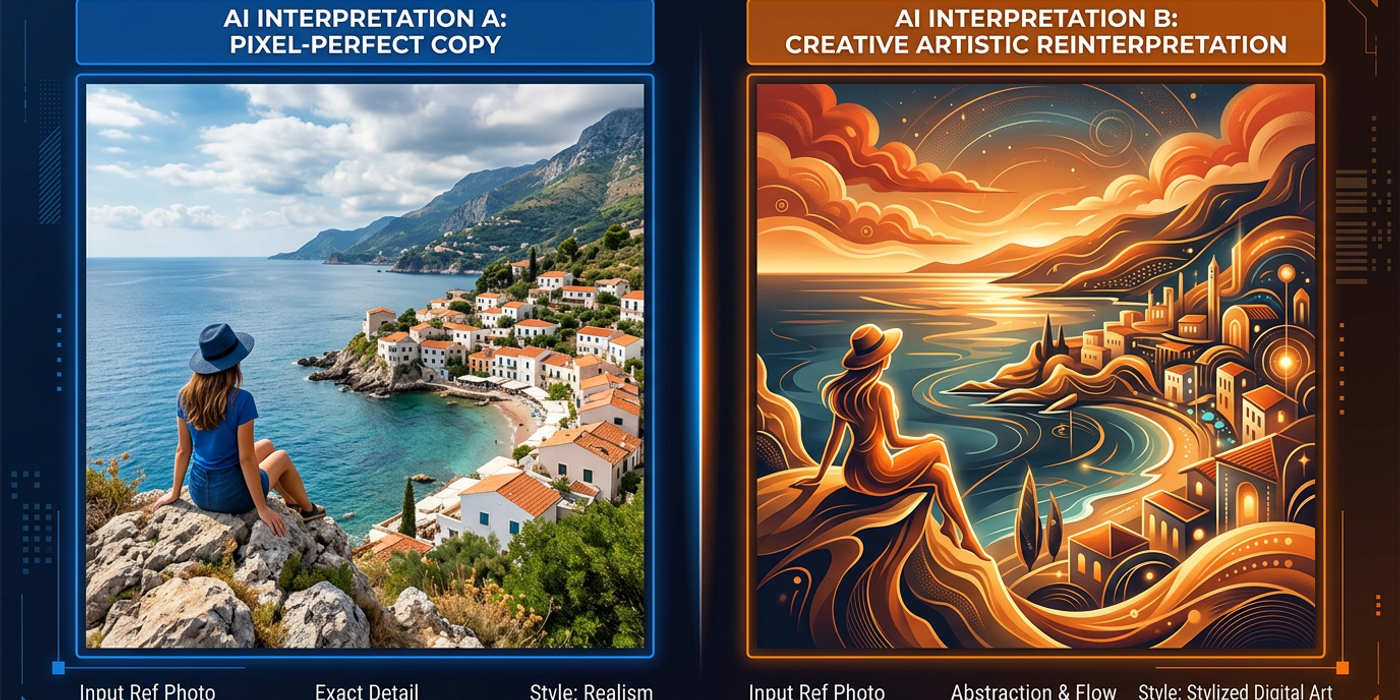
How late-2026 AI models handle reference images — from pixel-perfect reproduction to creative reinterpretation — and how to choose the right approach
Reference images are the backbone of consistent AI image generation, but in late 2026, how models handle them has diverged dramatically. Some models aim for near-identical reproduction — perfect for product shots and brand assets. Others treat your reference as creative inspiration, extracting style and composition while generating entirely new content. Understanding this fidelity spectrum is now the single most important skill for getting reliable results.
There is no "best" approach. The right choice depends entirely on what you're creating and how much creative freedom the model should have.
The Fidelity Spectrum — From Pixel Match to Artistic Inspiration
Every AI image model processes reference images through a different internal mechanism. Some encode the reference as a structural template, others as a style vector, and still others as a loose compositional guide. The result is a spectrum from near-perfect reproduction to free artistic interpretation.
On the precision end, models like Ideogram 4.0 and FLUX offer dedicated reference modes that preserve fine details — textures, exact colors, and spatial layout. On the creative end, models like ChatGPT Images 2.5 and xAI Imagine 2.0 treat reference images as starting points, generating new compositions that capture the essence without copying specifics.
Between these extremes lies the middle ground where most Hong Kong creators operate: enough fidelity for brand consistency, enough freedom to produce fresh content for each campaign.
Models That Prioritize Precision
Ideogram 4.0 — Since its open-weight release, Ideogram 4.0 has become the go-to for brand-accurate generation. Its color reference mode maps exact brand colors onto new outputs. The style reference mode extracts texture, lighting patterns, and material finishes — not just colors but the actual visual feel of your reference.
FLUX — FLUX models use structural reference encoding. They don't just learn your reference's appearance — they learn how elements relate spatially. This makes FLUX ideal for product photography where you need the same camera angle and lighting across a full catalog.
Seedream 4 — ByteDance's latest image model processes references through a two-stage pipeline: first extracting structural information, then applying stylistic transfer. This gives you independent control over composition and appearance, which is rare among precision-oriented models.
The trade-off is clear: the closer your output sticks to the reference, the less creative range you get. For e-commerce brands shooting 200 product variations, this is a feature. For campaigns that need visual freshness while maintaining brand recognition, it can be limiting.
Models That Prioritize Creative Interpretation
ChatGPT Images 2.5 — OpenAI's latest model takes a different approach. Rather than copying references, it understands the reference as context. Describe a mood board, and the model generates new scenes that share the same emotional tone and color palette — without reproducing any specific element. This is powerful for creative direction but unpredictable for brand consistency.
xAI Imagine 2.0 — Grok's image model treats references as "creative prompts in visual form." It extracts composition, lighting quality, and subject relationships, then builds new images around these abstracted features. The output often surprises you, which is ideal for brainstorming and concept development.
MAI-Image-2.5 — This late-2026 entrant takes the most aggressive creative approach. References are processed through a style embedding that captures the "vibe" — color temperature, contrast curve, texture density — but completely reimagines the subject and composition. For fashion brands that need visual variety within a consistent aesthetic, this is a powerful tool.
The risk is inconsistency. Run the same reference through ten times, and you get ten different images. For social media content where variety is the goal, this works perfectly. For pixel-perfect brand guidelines, it doesn't.
Hybrid Approaches — Dialing In the Right Fidelity Level
Several late-2026 models offer controls that let you slide along the fidelity spectrum, rather than being locked into one approach.
Qwen-Image-2.1 — Alibaba's open-weight model introduced a "reference strength" parameter from 0 (no influence) to 1.0 (maximum reproduction). At 0.3, the reference suggests composition without dictating details. At 0.8, you get recognizable reproduction with minor variations. This makes Qwen-Image-2.1 uniquely versatile for Hong Kong agencies switching between precision and creativity across different projects.
Nano Banana 2 — Google's model uses "layered conditioning." You provide a reference plus text describing which aspects to preserve — "keep the lighting, ignore the subject" or "keep the composition, change the colors." This selective control sits between pure precision and pure creativity.
FLUX 3 with ControlNet — The ControlNet integration gives you canny edge detection, depth mapping, and pose estimation from references. You can match the exact pose from a fashion shoot reference while changing the clothing and background completely. This hybrid approach is increasingly the standard for professional production work.
Practical Workflow: Choosing Your Fidelity Approach
For Hong Kong creative teams serving brands like HSBC, Lee Kum Kee, and the Tourism Board, the choice depends on asset type:
- Product photography catalogs → Precision models (Ideogram 4.0, FLUX) with reference strength at 0.7-0.9 - Social media campaigns → Hybrid models (Qwen-Image-2.1, Nano Banana 2) with reference strength at 0.3-0.5 - Creative concept development → Creative models (ChatGPT Images 2.5, MAI-Image-2.5) using reference as loose inspiration - Brand guidelines enforcement → Precision models with structural reference, verified against brand color swatches
The mistake most teams make is using one model for everything. In late 2026, the tools give you unprecedented control — the skill is knowing when to dial fidelity up and when to let the model run free.
Frequently Asked Questions
Q: What's the difference between color reference and style reference in Ideogram 4.0? A: Color reference maps specific brand colors onto new outputs. Style reference extracts texture, lighting patterns, and material finishes for a consistent visual feel.
Q: Can I control how much influence a reference image has? A: Yes. Qwen-Image-2.1 offers a reference strength parameter (0 to 1.0), while Nano Banana 2 uses layered conditioning where you specify which aspects to preserve.
Q: Which model is best for brand-consistent product photography? A: Ideogram 4.0 with color reference mode or FLUX with structural reference. Both prioritize precision and maintain consistency across large batches.
Q: Which model should I use for creative campaign concepts? A: ChatGPT Images 2.5 or MAI-Image-2.5. Both treat references as creative inspiration, generating fresh compositions that capture the reference's essence.
Q: How does Qwen-Image-2.1's reference strength parameter work? A: At 0.3, the reference suggests composition without dictating details. At 0.8, you get recognizable reproduction with minor variations.
Q: Can I use ChatGPT Images 2.5 for brand-consistent work? A: Not reliably. It treats references as context, not templates — excellent for creative direction but too unpredictable for pixel-perfect brand consistency.
Q: What is layered conditioning in Nano Banana 2? A: It lets you tell the model which aspects of the reference to preserve — "keep the lighting, ignore the subject" — giving selective control between precision and creativity.
Q: How should Hong Kong agencies choose between these approaches? A: Match the fidelity level to the asset type: precision for product catalogs, hybrid for social media, creative for concept development. One-size-fits-all is the most common mistake.