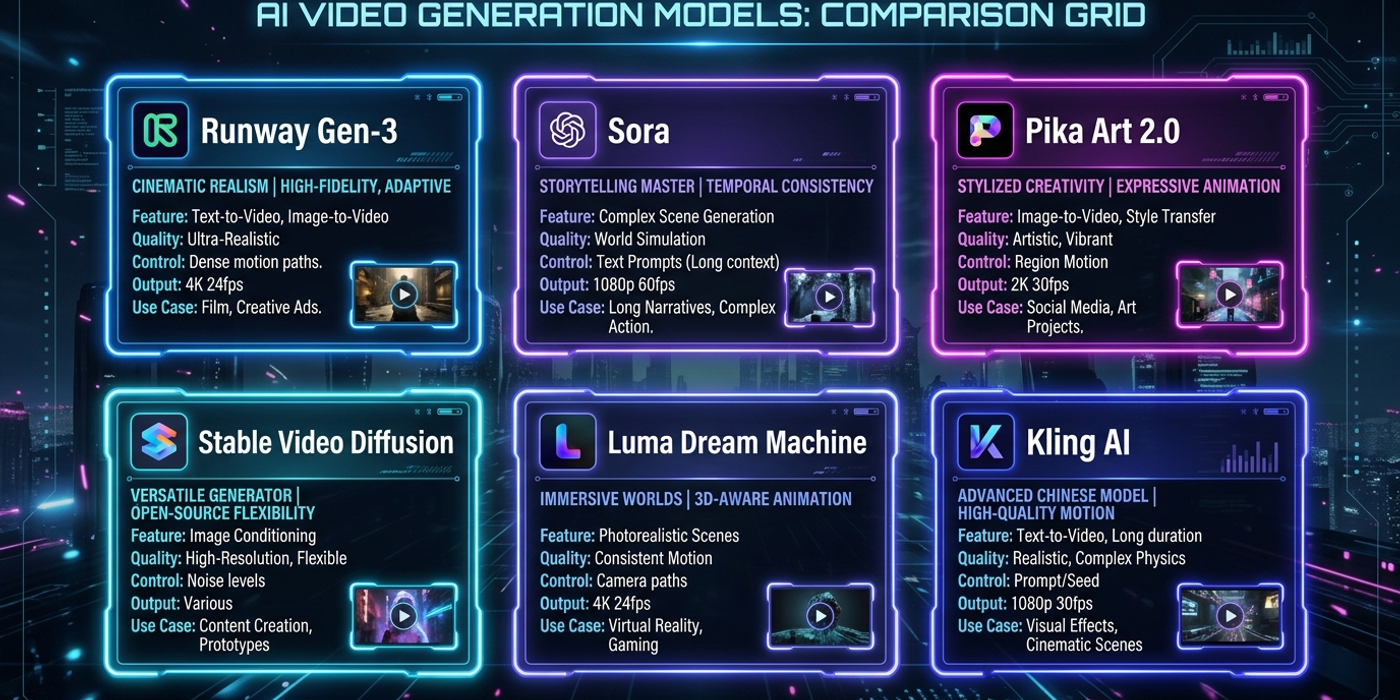
Veo 3.1, Kling 3.0, Seedance 2.5, FLUX 3 Video, LTX-2.5 and Wan3.0 face off. Compare quality, speed, and pricing to find the best AI video model in late 2026.
The AI video model landscape has doubled since mid-2026. When we last compared the big three — Veo 3.1, Kling 3.0, and Seedance 2.5 — FLUX 3 Video was still in preview, LTX-2.5 hadn't launched, and Alibaba Wan3.0 and Gemini Omni 1.1 Flash didn't exist. For Hong Kong creators, the bigger selection is good news but it also makes choosing the right tool more complex.
This guide compares six AI video models head-to-head across quality, speed, pricing, regional access, and specific production use cases.
Veo 3.1 — The Quality Benchmark
Google's Veo 3.1 remains the standard for cinematic output. Its physics simulation, camera control, and scene consistency are unmatched. For luxury brand content, real estate showcases, and corporate narratives, Veo still delivers the most reliable results. The biggest workflow change since August is Gemini Omni 1.1 Flash (Aug 31): a 360p draft mode that renders 30-second clips in under 2 minutes at 60% less cost. Draft with Omni Flash, finalize with Veo 3.1 — this cuts creative development time by 40-50%. Veo costs ~$0.15/second and integrates best with Google Cloud's Vertex AI.
Kling 3.0 — Speed + Best Text Rendering
Kuaishou's Kling 3.0 remains the fastest quality-to-speed option — 3-5 minutes for a 30-second 1080p clip. Its text rendering is the best of all six models, handling Chinese and English on-screen text more reliably than Veo or Seedance. For Hong Kong social ads, title cards, and product labels, this alone makes Kling indispensable. The physics gap with Veo has narrowed but not closed — complex interactions like liquid pouring and fabric folding still favor Veo.
Seedance 2.5 — Social-First, Single-Pass Output
ByteDance's Seedance 2.5 remains the only model generating 30-second clips in one pass without stitching. For TikTok, Instagram Reels, and YouTube Shorts, this workflow advantage is significant — one prompt, one render, one export. It tops out at 720p native (upscaling needed for 1080p) but CapCut integration makes post-production smooth. At ~$0.06/second, it's the cheapest of the original three, though LTX-2.5 (free, open weights) now challenges on price.
FLUX 3 Video — Native Audio & Open Weights
Black Forest Labs launched FLUX 3 Video with a key differentiator: native synchronized audio alongside video. No other major model does this in one pass, eliminating a separate audio generation step for social content. It produces 20-second clips at 1080p with strong prompt adherence, excelling at stylized and artistic content. Being open-weight, it can run on local hardware — valuable for agencies with compliance requirements common in financial-sector work.
LTX-2.5 — 4K HDR & Multi-Shot
Lightricks' LTX-2.5 arrived in August with native 4K HDR output — unmatched by any competitor. Its multi-shot generation produces wide, medium, and close-up variations of the same scene in one pass, maintaining character consistency across shots. The trade-off is speed: renders run 10-15 minutes for 30-second clips, comparable to Veo. As an open-weight model, it requires technical infrastructure to run efficiently but offers free inference.
Alibaba Wan3.0 — Document-to-Video
Alibaba's Wan3.0 generates 30-second video from text, images, PDFs, and PowerPoint slides. For Hong Kong agencies producing content from client briefs or pitch decks, this input flexibility is unique. Built on Alibaba Cloud with low latency from Hong Kong, it outputs at 1080p with cinematic style. Pricing is estimated ~$0.06-0.08/second.
Gemini Omni 1.1 Flash — Draft Tool for Creative Development
Google's Gemini Omni 1.1 Flash isn't a direct competitor — it's a different tier. Its 360p draft mode generates concept video at a fraction of the cost and time. Combined with smarter scene extension and external video references, it works best as a pre-visualization tool before final rendering with Veo or Kling.
Six Models at a Glance
| Feature | Veo 3.1 | Kling 3.0 | Seedance 2.5 | FLUX 3 Video | LTX-2.5 | Wan3.0 | |---------|---------|-----------|-------------|-------------|---------|--------| | Resolution | 1080p | 1080p | 720p | 1080p | 4K HDR | 1080p | | Max Duration | 60s | 60s | 30s | 20s | 30s | 30s | | Speed (30s) | 8-12 min | 3-5 min | 4-6 min | 6-10 min | 10-15 min | 5-8 min | | Native Audio | ✗ | ✗ | ✗ | ✓ | ✗ | ✗ | | Open Weights | ✗ | ✗ | ✗ | ✓ | ✓ | ✗ | | Text Rendering | Good | Excellent | Fair | Good | Fair | Good | | APAC Access | Good | Excellent | Excellent | Moderate | Moderate | Excellent | | Pricing/s | ~$0.15 | ~$0.08 | ~$0.06 | ~$0.10 | Free | ~$0.06-0.08 |
Which Model Should You Use?
For premium brand content: Veo 3.1. Draft with Gemini Omni Flash to iterate quickly, render finals with Veo.
For high-volume social media: Seedance 2.5 for TikTok and Reels, FLUX 3 Video when you need native audio, Kling 3.0 for ads with text overlays.
For 4K production and narrative coverage: LTX-2.5 is the only native 4K HDR option. Its multi-shot generation saves time on projects requiring multiple angles.
For client pitch-to-production workflows: Alibaba Wan3.0 turns briefing documents into video directly.
For budget-conscious agencies: LTX-2.5 (free) and Kling 3.0 (~$0.08/s) deliver the best cost-to-quality ratios.
The hybrid approach wins. Most Hong Kong agencies now maintain a 3-model stack: one premium model (Veo or LTX), one speed model (Kling), and one social-volume model (Seedance or FLUX). This covers every deliverable without overpaying.
Frequently Asked Questions
Q: Is Veo 3.1 still worth the premium price with new competitors? A: Yes, for premium content where physics accuracy matters. For daily social content, Kling or Seedance deliver comparable results at half the cost.
Q: Can FLUX 3 Video's native audio replace a separate voiceover workflow? A: For simple social content, yes. For multilingual narration or precise audio timing, you'll still need a dedicated audio tool.
Q: Is LTX-2.5's 4K HDR output ready for broadcast? A: Yes, but current render speeds make it best suited for hero content rather than high-volume production.
Q: Which model works best for Chinese-language content? A: Kling 3.0 leads for text rendering in Chinese and English. FLUX 3 Video and Seedance are strong for voiceover needs.
Q: Can I use multiple models in a single project? A: Absolutely. The most effective HK agencies use Veo or LTX for hero assets, Kling for variations, and Seedance or FLUX for daily social output.
Q: Are open-weight models practical for agency use? A: If you have GPU capacity and setup time, the cost savings are significant. Otherwise, managed APIs on cooly.ai are more practical.
Q: How has the landscape changed since mid-2026? A: The model count doubled. FLUX 3 Video (native audio), LTX-2.5 (4K HDR), and Wan3.0 (document-to-video) opened new use cases that didn't exist in mid-2026.
Q: Which model has the best API integration for post-production pipelines? A: Veo 3.1 (Vertex AI) and Kling 3.0 (REST API) have the most mature integrations. FLUX and LTX APIs are newer. Seedance integrates best with CapCut.