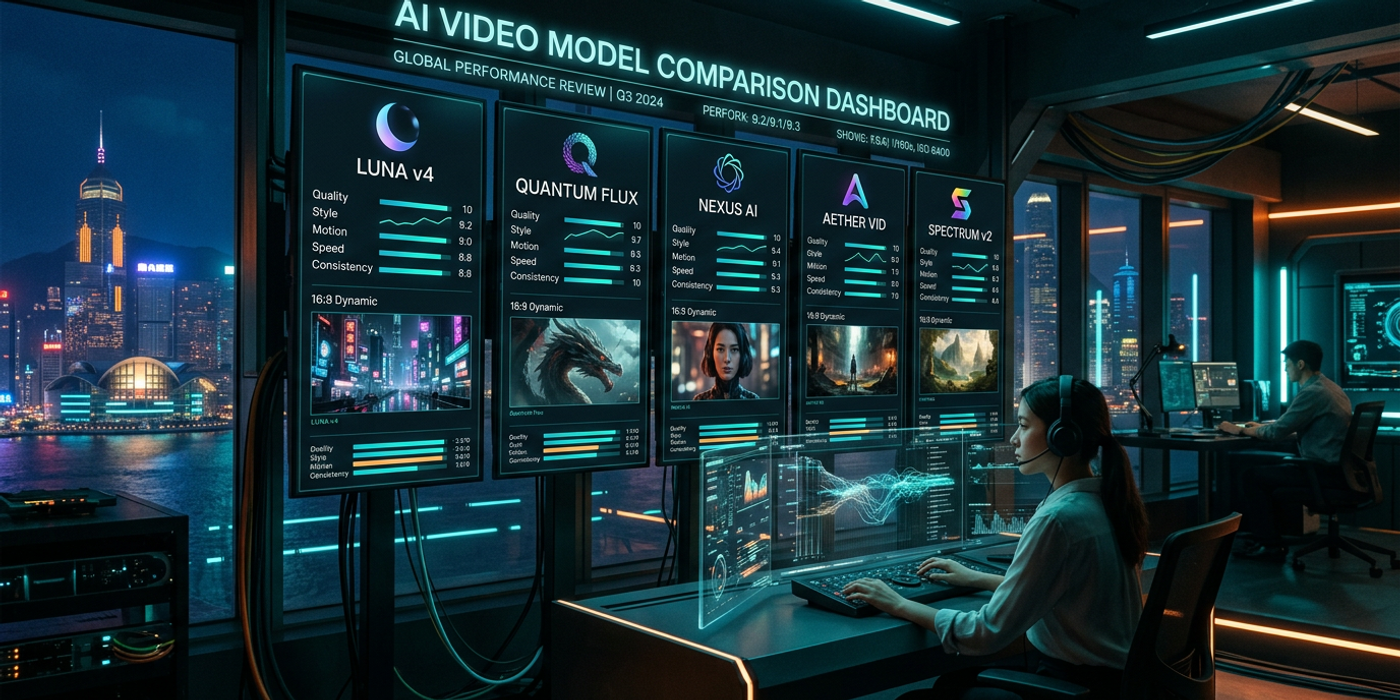
With models launching weekly, choosing the right AI video model for HK marketing is harder than ever. Here's how to pick the best one for your brief.
The AI video landscape has changed dramatically since mid-2026. What was once a straightforward choice between Veo 3.1, Kling 3.0, and Seedance has become a fragmented ecosystem of a dozen competing models — each with unique strengths, pricing structures, and output capabilities. For Hong Kong marketers trying to produce high-quality campaigns efficiently, the hardest question now is not "how do I make AI video work" but "which model should I use for this specific brief?"
This guide breaks down the current AI video model landscape and gives you a practical framework for matching models to common Hong Kong marketing use cases.
The New AI Video Landscape
The past four months have brought an unprecedented wave of new models to Hong Kong's creative toolkit:
- FLUX 3 Video from Black Forest Labs — now GA with 20-second clips and native audio output - Seedance 2.5 from ByteDance — 30-second video generation with built-in audio tracks - LTX-2.5 — open-weights video generation supporting multi-shot workflows and 4K HDR - Alibaba Wan3.0 — 30-second video from text, images, or documents - MiniMax H3 — video generation with native stereo audio - Gemini Omni 1.1 Flash — conversational video editing with draft mode and scene extension
These join the established players — Veo 3.1 (Google), Kling 3.0, and the original Seedance — to create a market where no single model dominates all use cases. The smartest Hong Kong agencies are no longer asking "which one is best" but building multi-model pipelines that route each brief to the right model.
Choosing by Use Case
Brand Commercials and Cinematic Content
When your client demands a polished, film-grade result — a Tourism Board campaign, a luxury brand launch, or a high-end property showcase — reach for Veo 3.1. It remains the gold standard for camera control, natural lighting, and realistic motion. No other model handles slow tracking shots, shallow depth of field, and cinematic colour grading as consistently.
FLUX 3 Video is a strong secondary option here, especially for shorter clips (up to 20 seconds) where its native audio output saves a post-production step. If you're producing a series of 15-second social cuts for a luxury hotel campaign, FLUX 3's consistent style across generations makes it an efficient choice.
Social Media Content at Scale
For high-volume social media content — Instagram Reels, TikTok videos, Facebook ads — speed and cost efficiency matter more than absolute quality. Seedance 2.5 and Kling 3.0 both excel here. Seedance 2.5's 30-second clips with built-in audio are ideal for fast-turnaround organic content, while Kling 3.0 handles stylised and experimental formats that stand out in crowded feeds.
Gemini Omni 1.1 Flash adds a new option: conversational video editing via chat. You can generate a draft, describe a change, and get a new version in seconds. For rapid A/B testing of creative directions before committing to a full production run, this is a game-changer.
Long-Form and Documentaries
For content longer than 30 seconds — brand documentaries, explainer videos, or educational content — no single model generates full-length output. The winning approach is multi-shot pipelines: use LTX-2.5 or Alibaba Wan3.0 for longer individual clips (30 seconds each), then assemble and edit in your NLE of choice.
LTX-2.5's open-weights model is particularly interesting for Hong Kong agencies with technical capability. You can run it locally, fine-tune it on brand-specific visual styles, and avoid per-generation API costs. Wan3.0, meanwhile, accepts document inputs — so you can feed a script and get a matching video without writing detailed prompts shot by shot.
Video with Audio
A major shift in late 2026 is that several models now output audio alongside video. Seedance 2.5 and FLUX 3 Video both generate native audio — background ambience, matching sound design, or scene-appropriate music. MiniMax H3 takes this further with stereo audio output that responds to visual content.
This eliminates a significant post-production cost for simple projects. If your brief calls for a product demo or social clip where the audio is atmospheric rather than narrative-driven, these models can save you an entire editing pass.
Building Your Multi-Model Pipeline
The most efficient Hong Kong production teams in late 2026 use a three-stage pipeline:
1. Rapid ideation — Gemini Omni Flash for draft generation and creative exploration (fast, cheap, conversational) 2. Primary production — Veo 3.1 or Seedance 2.5 for the final clips (quality-focused, use-case dependent) 3. Augmentation — FLUX 3 Video or MiniMax H3 for clips that need native audio (reduces post-production)
This may sound complex, but platforms like Cooly Studio handle model switching seamlessly — you don't need separate accounts or workflows for each model. The key is knowing which model to reach for when the brief comes in.
Frequently Asked Questions
Q: Is Veo 3.1 still the best overall AI video model in late 2026? A: For premium cinematic quality, yes — Veo 3.1 remains unmatched in camera control and realism. But for specific use cases like social media volume or audio-native output, newer models like Seedance 2.5 and FLUX 3 Video may be more efficient.
Q: How do I choose between Seedance 2.5 and Kling 3.0 for social content? A: Use Seedance 2.5 when you need built-in audio or longer clips (up to 30 seconds). Use Kling 3.0 when you want a stylised, artistic look that differentiates your content on crowded feeds.
Q: Can I run LTX-2.5 locally in Hong Kong for client work? A: Yes, if you have the GPU hardware. LTX-2.5 is open-weights and can run on consumer-grade GPUs with optimised inference. This makes it attractive for agencies that want to avoid per-generation costs on high-volume projects.
Q: Which model handles Cantonese cultural context best? A: Veo 3.1 and Seedance 2.5 both respond well to prompts containing Hong Kong-specific references (Central, TST, dim sum, traditional architecture). The key is in the prompt — include location cues and cultural markers regardless of which model you choose.
Q: How many models should a Hong Kong marketing team master? A: Start with two — Veo 3.1 for premium work and Seedance 2.5 for volume. Add FLUX 3 Video when audio output matters and LTX-2.5 for technical projects. Two is enough for most campaigns; three to four covers nearly every scenario.
Q: Is native audio output good enough for client delivery? A: For short-form social content and internal approvals, yes. For broadcast-quality client delivery, treat AI-generated audio as a scratch track and layer professionally produced sound design in post-production.
Q: Do newer models make the original checklist approach obsolete? A: Not at all — the production checklist (pre-production, prompt iteration, post-production, export) still applies. What changes is the model selection step, which now requires more careful consideration of which tool fits which brief.