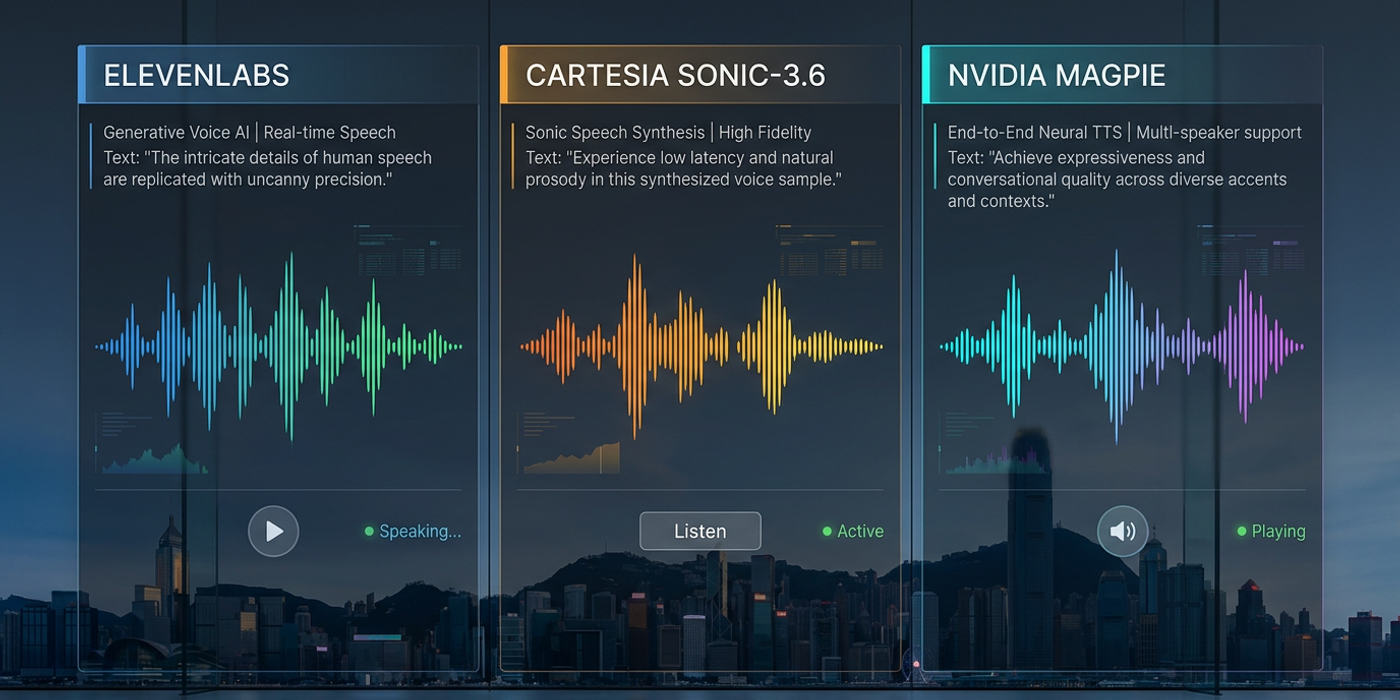
Updated AI voice guide for late 2026 — new models like NVIDIA Magpie and Cartesia Sonic-3.6, updated rankings, and practical HK video workflow tips.
The AI voice generation landscape has shifted significantly since our mid-2026 TTS showdown. New models like NVIDIA Magpie and Cartesia Sonic-3.6 have entered the arena, while established players like ElevenLabs, PlayHT, and MiniMax have pushed major updates. For Hong Kong video creators and agencies, this means more choices — but also more complexity in selecting the right voice engine for each project.
In this updated guide, we break down what's changed, how the models compare now, and how to match the right AI voice to your video production workflow.
What Changed Since Mid-2026
The most notable shift since July 2026 is the emergence of open-weight AI voice models. NVIDIA Magpie TTS launched as a fully open-weight model supporting 12 languages, including Cantonese — a major development for Hong Kong creators who need bilingual content without per-character API costs.
Cartesia quietly pushed Sonic from version 3.0 to 3.6, which now tops both the quality and speed leaderboards on Artificial Analysis. With sub-90ms latency and improved emotional range, Sonic-3.6 has become the go-to for real-time and live applications.
ElevenLabs refined their Turbo v3 with better Cantonese pronunciation support, addressing a key pain point for HK users. MiniMax Speech 2.0 received an update improving long-form reading consistency — previously its main weakness.
Updated Model Landscape for 2026
ElevenLabs Turbo v3 remains the industry benchmark for overall voice quality and emotional range. The August 2026 update brought improved Cantonese and Mandarin accent handling, making it the safest choice for HK creators producing bilingual content.
Cartesia Sonic-3.6 is the new speed champion with competitive voice quality. Its sub-90ms latency makes it ideal for live-streaming, interactive voice applications, and rapid video narration where turnaround time matters most.
NVIDIA Magpie TTS is the most significant new entrant. Its open-weight release means you can self-host and generate unlimited voices without per-character billing — a game-changer for agencies producing large volumes of content. The model supports 12 languages including Cantonese, though its emotional range still lags behind ElevenLabs.
PlayHT 3.0 continues to excel at long-form narration. The model's natural pacing and breath control make it ideal for documentary voiceovers and e-learning content over five minutes long.
MiniMax Speech 2.0 remains the top choice for emotionally expressive content. The August update improved paragraph-to-paragraph consistency, fixing the timing quirks that reviewers noted in the original version.
OpenAI TTS HD delivers the clearest, most consistent pronunciation — ideal for product demos and brand-safe corporate content where you need zero emotional variance.
Fish Audio 2.0 remains a strong free option for budget-conscious indie creators, though its quality gap vs. paid models has widened slightly as competitors improved faster.
Matching Voice to Video Workflow
Different video formats demand different voice characteristics:
Social media ads (15-60 seconds): Speed and emotional punch matter most. Cartesia Sonic-3.6 or MiniMax Speech 2.0 deliver quickly with expressive delivery suited for short attention spans.
Product demos and tutorials: Clarity and consistency are paramount. OpenAI TTS HD or ElevenLabs Turbo v3 ensure every instruction lands without ambiguity.
Documentary and long-form narration (5+ minutes): Natural pacing prevents listener fatigue. PlayHT 3.0 or ElevenLabs Turbo v3 maintain quality across extended reads.
Live streaming and interactive content: Sub-100ms latency is non-negotiable. Cartesia Sonic-3.6 is the clear choice here.
Bulk bilingual production (Cantonese + English): Self-hosting with NVIDIA Magpie eliminates API costs at scale, while ElevenLabs offers the best quality for polished deliverables.
Cantonese and Multilingual Voice Quality
Hong Kong creators face unique challenges: most TTS models are trained primarily on English data, and Cantonese support varies significantly.
ElevenLabs Turbo v3 now handles Cantonese with improved tonal accuracy, though it still slightly favours Mandarin. NVIDIA Magpie supports Cantonese natively as one of its 12 launch languages, and self-hosting lets you fine-tune for tonal precision. PlayHT 3.0 covers both Cantonese and English in its 140+ language library with solid pronunciation accuracy.
For bilingual content — a staple of Hong Kong marketing — the safest approach is to use one model for both languages rather than switching mid-project. This maintains voice consistency even when the language changes.
Frequently Asked Questions
Q: Which AI voice model sounds most natural in late 2026? A: ElevenLabs Turbo v3 still leads in overall naturalness and emotional range, but Cartesia Sonic-3.6 is now extremely close in quality while being much faster.
Q: Can I use AI voice generation for commercial projects in Hong Kong? A: Yes, but check each model's licensing terms. ElevenLabs, PlayHT, OpenAI, and Cartesia offer commercial licenses. NVIDIA Magpie's open-weight MIT license permits commercial use including resale.
Q: How much does AI voice generation cost per minute in late 2026? A: ElevenLabs charges roughly $0.30/min, PlayHT $0.20/min, and OpenAI $0.15/min. Self-hosted NVIDIA Magpie costs only your compute — roughly $0.01/min on a consumer GPU.
Q: Which TTS model works best for Cantonese voiceovers? A: ElevenLabs Turbo v3 offers the best overall quality. NVIDIA Magpie is the best self-hosted option. PlayHT 3.0 also provides solid Cantonese support in its library.
Q: Is Cartesia Sonic-3.6 better than ElevenLabs for voiceover work? A: It depends on your priority. Sonic-3.6 wins on speed and latency. ElevenLabs wins on emotional range and voice library depth. For standard narration, both deliver professional quality.
Q: How do I avoid AI voice sounding robotic in my video projects? A: Use models with emotional range like ElevenLabs or MiniMax, add natural pauses with punctuation, break long sentences into shorter ones, and layer background audio to mask subtle artifacts.
Q: What's the best free AI voice option for Hong Kong indie creators? A: NVIDIA Magpie — self-hosted with MIT license and native Cantonese support. Fish Audio 2.0 is also solid but has fewer language options.
Q: Can I generate Cantonese and English voiceovers in the same project? A: Yes. ElevenLabs, PlayHT, and NVIDIA Magpie all support switching between languages mid-project while keeping the same voice character.