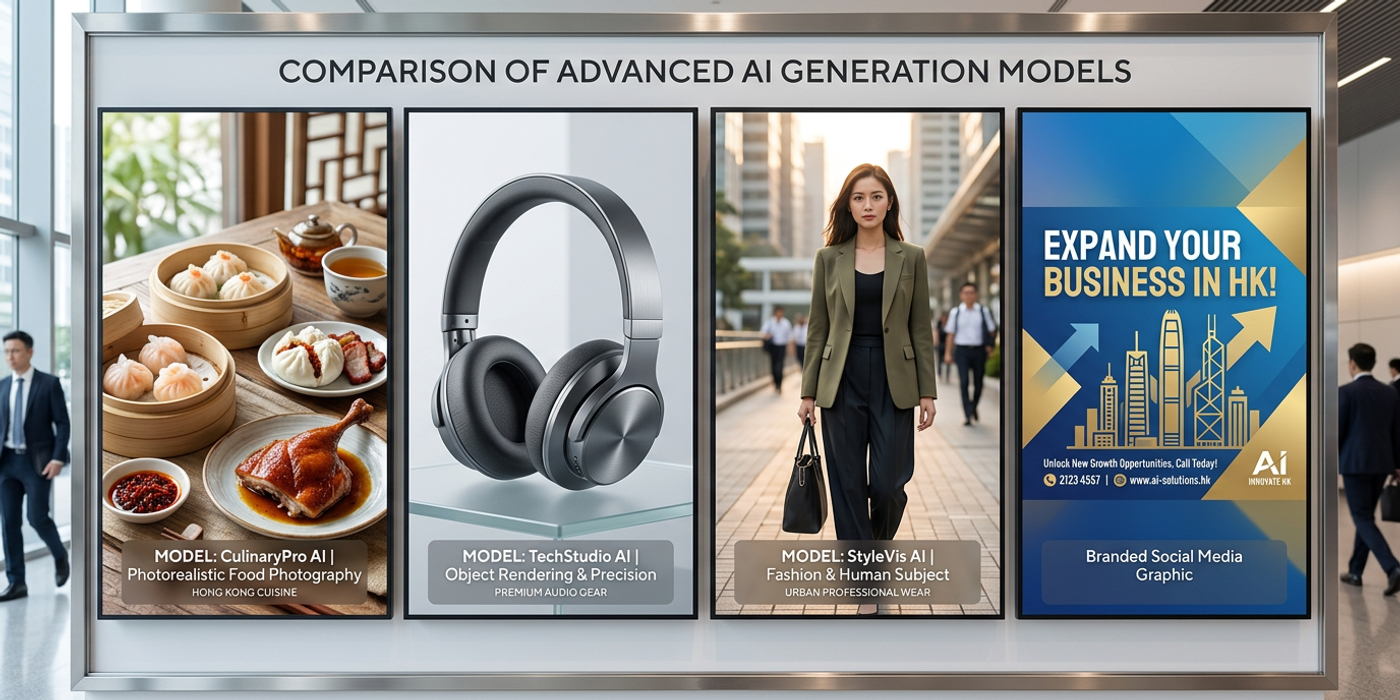
Best AI image tools for Hong Kong businesses in late 2026. From Seedream 4 to Ideogram 4.0 — we compare quality, speed, cost, and bilingual support.
The AI image generation market doesn't stand still — and neither should your toolkit. Since our mid-2026 guide, several new models have launched, pricing has shifted, and some surprising dark horses have emerged. For Hong Kong businesses producing product photography, marketing collateral, and social media content, the question remains: which tools actually deliver ROI?
We've tested the major players across quality, speed, cost, and bilingual support to bring you this late-2026 update.
Seedream 4 — Still the All-Rounder Champion
ByteDance's Seedream 4 remains the go-to model for Hong Kong businesses, and for good reason. It excels at photorealism, handles complex prompts reliably, and offers the most consistent output across both English and Chinese language prompts — a must for bilingual HK campaigns.
Since mid-2026, Seedream 4 has received steady quality improvements. The latest pipeline optimisations cut generation time by roughly 20%, making it even more practical for bulk product shot workflows. It's available on Cooly Studio at competitive credit rates, and its style consistency across generations makes it ideal for brands that need cohesive visual identities.
Best for: Product photography, lifestyle imagery, bilingual marketing assets, bulk generation workflows.
Nano Banana 2 — Speed Demon with a Price Tag
Google DeepMind's Nano Banana 2 remains the fastest consumer-grade image model on the market — sub-second generations in many cases. For Hong Kong e-commerce businesses that need hundreds of product shots fast, it's unbeatable.
The catch hasn't changed: it's pricier per generation than Seedream 4, and its style range is narrower. Nano Banana 2 strongly favours photorealism over artistic or illustration styles. In late 2026, it's best deployed as a specialised tool for high-volume photorealistic output rather than a general-purpose workhorse.
Best for: High-volume e-commerce photography, rapid prototyping, photorealism-first projects.
GPT-Image-2 — The New Contender
OpenAI's GPT-Image-2 launched to significant buzz and earns it for prompt adherence and compositional understanding. The model excels at following complex instructions like "rule of thirds" or "leading lines" — among the best of any current model.
However, GPT-Image-2 has two caveats for HK businesses: it's currently weak at non-Latin text rendering (Chinese characters in generated images are often garbled), and its per-generation pricing is premium-tier. It's great for mood boarding, editorial, and presentation assets, but less suited to production-scale work.
Best for: Editorial content, concept visualisation, high-end presentation materials.
Ideogram 4.0 — The Text Rendering King
Ideogram 4.0, which launched in June 2026 as an open-weight model, remains unmatched for text rendering in images. For Hong Kong businesses creating social media graphics, promotional banners, or any content where legible text in the image matters, Ideogram 4.0 is the clear choice.
Its native 2K resolution output means less upscaling overhead — a genuine time saver for agencies producing print-ready assets. The open-weight release also enables self-hosted deployments for enterprises with compliance requirements, though most HK businesses will prefer the convenience of cloud-based access.
Best for: Social media graphics with text, promotional banners, print-ready assets, self-hosted enterprise deployments.
Microsoft MAI-Image-2.5 — The Stealth Competitor
Microsoft's MAI-Image-2.5 has quietly climbed to competitive positions on the leaderboard, matching Nano Banana 2 on several benchmarks. Its key advantage for Hong Kong businesses: Azure integration. If you're already in the Microsoft ecosystem, MAI-Image-2.5 slots into existing workflows with minimal friction.
Image quality is strong across photorealism and illustration styles, though it doesn't excel as dramatically as category leaders in any single dimension. It's the "good enough, well-integrated" option that makes sense for Microsoft-centric agencies.
Best for: Microsoft ecosystem users, balanced quality across styles, enterprise compliance workflows.
Comparing Costs in Late 2026
Credit consumption varies significantly between models. On Cooly Studio, typical cost-per-image ranges from 5–10 credits for Seedream 4, 12–20 credits for Nano Banana 2, and 8–15 credits for GPT-Image-2. Ideogram 4.0 generally falls in the 6–12 credit range.
For Hong Kong businesses watching budgets, the smart strategy is model-tiering: use Seedream 4 for 70-80% of work, Ideogram 4.0 for text-heavy graphics, and reserve Nano Banana 2 and GPT-Image-2 for projects where their specific strengths justify the premium.
Your Late 2026 Toolkit
If you're a Hong Kong agency or in-house brand team, build your toolkit around Seedream 4 as your primary model. Supplement with Ideogram 4.0 for any text-in-image work. Bring in Nano Banana 2 only when speed or maximum photorealism is the priority. Use GPT-Image-2 for high-end conceptual work and client presentations.
Avoid locking into a single model. The landscape changes faster than ever, and the best strategy is to be model-agnostic — able to switch between generators as new releases shift the value equation. Cooly Studio's multi-model support makes this straightforward.
Frequently Asked Questions
Q: Which AI image model is best for Cantonese-language text in images? A: No model handles Chinese text in generated images perfectly, but Seedream 4 has the most consistent performance with Chinese prompts and bilingual outputs. For text-overlaid images, pair generation with a separate text rendering step.
Q: Is GPT-Image-2 worth the premium pricing for Hong Kong businesses? A: For concept development, editorial content, and client presentations — yes. For bulk production work — no. Reserve it for projects where its prompt adherence adds clear value.
Q: Can Nano Banana 2 replace Seedream 4 as a daily driver? A: Not for most Hong Kong businesses. Nano Banana 2's speed is impressive, but its narrower style range and higher per-generation cost make it better as a specialised tool than a primary workhorse.
Q: Has Ideogram 4.0 improved since its June 2026 launch? A: Yes — community fine-tunes and better pipeline integrations have improved its output consistency. Its text rendering capability remains best-in-class for English text in images.
Q: What's the best strategy for keeping AI image costs low in late 2026? A: Model-tiering. Use affordable models for 70-80% of work, reserve premium models for projects that genuinely need their strengths. Batch generations to minimise idle pipeline overhead.
Q: Is it worth learning multiple AI image models? A: Absolutely. Each model has distinct strengths. A Hong Kong agency that can switch between Seedream 4, Nano Banana 2, GPT-Image-2, and Ideogram 4.0 depending on the job will consistently outperform one locked into a single tool.
Q: How important is reference image support for Hong Kong businesses? A: Critically important for brand consistency. Seedream 4 and Ideogram 4.0 both support image-to-image workflows that maintain brand styles. When evaluating any new model, check if it supports reference image conditioning.
Q: Are there any new models expected to launch soon? A: Multiple labs have teased next-generation models. XAI is reportedly working on an image generation model, and Stability AI has hinted at Stable Diffusion 4. Competitive pressure means pricing will likely continue to decrease through the end of 2026.