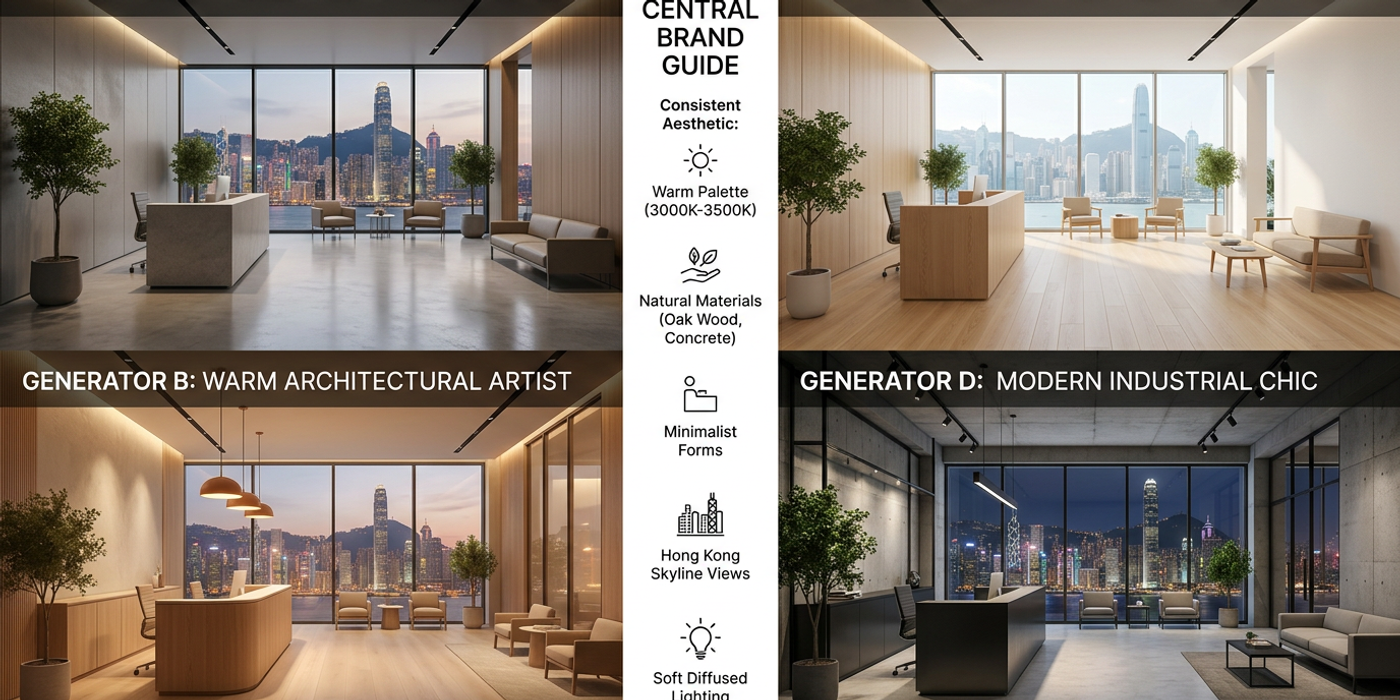
Hong Kong brands using different AI image models struggle with visual inconsistency. Here's how to maintain brand identity across generators in late 2026.
Hong Kong brands are no longer using a single AI image generator. Most agencies now juggle three or more models — ChatGPT Images 2.5 for quick social posts, Nano Banana 2 for polished product shots, FLUX Schnell for rapid prototyping, and Stable Diffusion for fine-grained control. Each model interprets prompts differently, applies different stylistic biases, and produces visually distinct outputs from the same text. The result: brand identity fragments across channels.
Managing visual consistency across multiple AI generators is the defining challenge of late 2026 creative production. This guide covers the practical strategies that Hong Kong agencies use to keep their brand intact when their toolset expands.
Why Different Models Give Different Results
Every AI image model has a visual fingerprint — subtle biases baked in during training. Nano Banana 2 leans toward cinematic, high-contrast compositions. FLUX Schnell prioritises speed over stylistic nuance. ChatGPT Images 2.5 applies a cleaner, more commercial aesthetic by default. Stable Diffusion, depending on the checkpoint, can produce anything from photorealistic to painterly outputs.
These fingerprints become invisible problems when you distribute prompts across tools. The same prompt — "a minimalist Hong Kong office lobby, natural lighting, morning" — produces recognisably different images from each model. For a single social post this is acceptable. For a brand campaign running across billboards, digital ads, and product packaging, it breaks the illusion.
The fix is not to standardise on one model. Each tool has a reason to be in your stack. The fix is to build a cross-model brand system.
Building Your Brand Reference Kit
Hong Kong agencies that maintain consistent brand identity across models share one practice: they invest in reference materials before they generate.
Start with a brand colour palette mapped to hex values. Most AI models interpret colour descriptions inconsistently. "Warm beige" yields different results in Nano Banana 2 versus ChatGPT Images 2.5. Supplying exact hex values in your prompts gives the model a concrete target.
Next, curate a set of reference images — five to ten brand-approved photographs showing the visual style you want. These serve as anchors. Models that support image inputs (ChatGPT Images 2.5, Nano Banana 2, Stable Diffusion with ControlNet) can use these as direct style references. For models that only accept text, describe the reference images in detail.
Finally, document your prompt templates per model. A prompt that works perfectly in ChatGPT Images 2.5 may fail in FLUX Schnell because the keyword syntax differs. Maintain a spreadsheet or Notion database with model-specific prompt variants for your core brand use cases.
Model-Specific Prompt Adaptations
Each generator requires tweaks to achieve the same visual outcome. Here is a practical framework based on what Hong Kong agencies are using in production.
For ChatGPT Images 2.5, use the sketch mode as a planning layer. Generate a rough composition first, then iterate the prompt for the final render. This reduces wasted credits on direction experiments.
For Nano Banana 2, lean into its cinematic strength. Specify lighting conditions explicitly — "golden hour, soft shadows, shallow depth of field" — because the model interprets these precisely. Avoid ambiguous style words like "modern" or "clean" without qualifiers.
For FLUX Schnell, keep prompts simple and compositional. The model produces better results with short, noun-heavy prompts than with elaborate aesthetic descriptions. Focus on subject, setting, and framing.
For Stable Diffusion, use a consistent base checkpoint across generations. Switching between different finetuned models mid-campaign introduces unpredictable style drift. Lock one base model and prompt around it.
The Hong Kong Brand Workflow
Local agencies serving HSBC, HKTB, and Lee Kum Kee have developed a repeatable cross-model pipeline.
The workflow starts with a brand brief encoded as a structured prompt foundation. This foundation includes the brand's colour hexes, lighting preference, composition style (product hero, lifestyle, environmental), and any banned visual elements — gritty textures, oversaturated tones, or specific cultural references.
Before full production, run a style calibration test. Generate four versions of a single brief across your target models. Review them as a team and calibrate. Adjust each model's prompt variant until all four outputs converge visually. This calibration step takes one hour per campaign and saves days of post-production fixing.
During production, maintain a visual log. For each generated image, note which model, which prompt variant, and which reference images were used. When a campaign extends to new models — adding Veo 3.1 for video or FLUX 3 Video — you can extend the same system rather than starting from scratch.
After the campaign, archive the full prompt set. Six months later when the next round of assets needs to match the same brand identity, the archived prompts make re-generation predictable.
Frequently Asked Questions
Q: Should my agency standardise on just one AI image model for brand consistency? A: No. Standardising sacrifices the specific strengths each model brings. Build a cross-model prompt system that translates your brand identity into each model's language.
Q: How many reference images do I need for consistent brand style? A: Five to ten brand-approved photographs covering your primary visual use cases — product shots, lifestyle scenes, and environmental compositions.
Q: Can I use the same prompt across different AI models? A: Rarely. Each model parses keywords differently. Always maintain model-specific variants of your core prompts.
Q: How often should I update my brand reference kit? A: Update it whenever you add a new model to your production pipeline or when your brand visual guidelines change.
Q: Does ChatGPT Images 2.5 support reference image inputs? A: Yes, ChatGPT Images 2.5 accepts images as style references and produces outputs that match the reference closer than text-only prompting.
Q: What is the biggest mistake Hong Kong agencies make with cross-model branding? A: Assuming a single prompt produces identical results across models. The prompt that works in Stable Diffusion may produce completely different colours in Nano Banana 2.
Q: How does video generation fit into brand consistency? A: Start with your image brand system and extend the colour palette, lighting, and reference images to video models like Veo 3.1 and FLUX 3 Video. The same hex values and style reference principles apply.
Q: Can small teams with limited budgets implement cross-model brand systems? A: Yes. Start with a simple spreadsheet tracking model-specific prompt variants for your top three use cases. The system scales as your team grows.