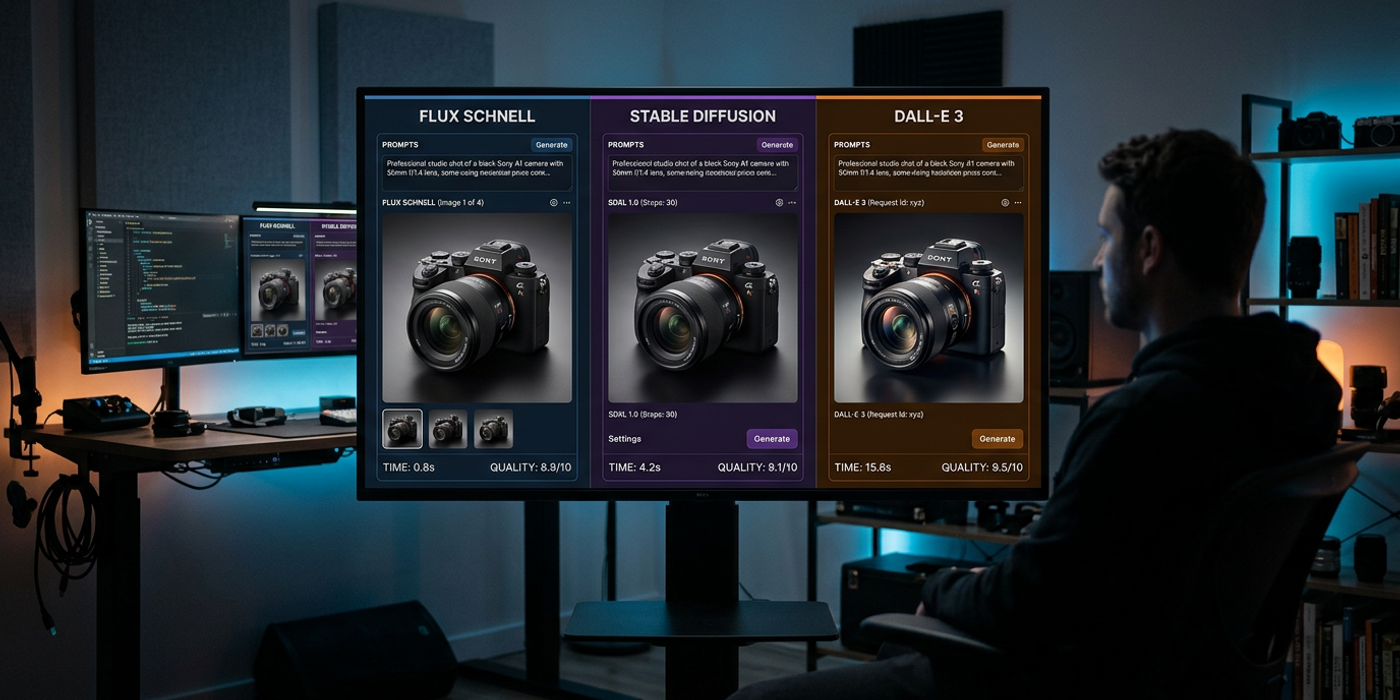
A practical benchmark guide comparing Flux Schnell, Stable Diffusion and DALL-E 3 on speed, quality and cost for Hong Kong creators in late 2026 workflows.
The classic trio of AI image generators — Flux Schnell, Stable Diffusion, and DALL-E 3 — remains central to many creative workflows in Hong Kong. But the landscape around them has shifted dramatically since mid-2026, with new contenders and model updates changing how these three compare on speed, quality, and cost. This guide provides up-to-date benchmarks to help you choose the right tool for each creative task.
Generation Speed: How Fast Does Each Model Deliver?
Speed is often the deciding factor in production environments where clients expect rapid iterations. Here is how the three models stack up on standard 1024x1024 image generation as of September 2026, measured on consumer-grade hardware (RTX 4090 for local models and standard API tier for cloud models):
Flux Schnell — 1.2 to 2.5 seconds per image locally. Black Forest Labs continues to optimise inference, and the latest Schnell variants run faster than any competing model at equivalent quality. The trade-off is reduced prompt adherence compared to slower models, particularly on complex multi-subject compositions.
Stable Diffusion (SDXL and SD3.5) — 2.5 to 5 seconds per image locally on SDXL, and 4 to 8 seconds on SD3.5. The community fine-tune ecosystem remains the deepest of any model — if you need a specialised checkpoint for anime, product photography, or architectural visualisation, Stable Diffusion is the only option with thousands of pre-trained variants.
DALL-E 3 (via OpenAI API) — 6 to 12 seconds per image. DALL-E 3 has not received a generation-speed update since late 2025, and OpenAI has shifted focus to GPT-Image-2 for faster inference. DALL-E 3 remains usable but is the slowest of the three for production pipelines.
Image Quality: Detail, Coherence and Prompt Adherence
Quality benchmarking requires separating three dimensions: photorealism, prompt adherence, and creative flexibility.
Photorealism: DALL-E 3 still leads on out-of-the-box photorealism for natural scenes, particularly human faces and skin texture. However, Stable Diffusion fine-tunes like Juggernaut XL and RealVis XL now match or exceed DALL-E 3 on portrait photography and product shots. Flux Schnell produces clean, well-lit images but cannot match the texture fidelity of the other two without post-processing.
Prompt adherence: This is where the gap has narrowed most. Stable Diffusion 3.5 introduced significantly better prompt comprehension than SDXL, closing much of the gap with DALL-E 3. Flux Schnell still struggles with prompts containing more than three distinct subjects or specific spatial relationships — a limitation baked into its architecture.
Creative flexibility: Stable Diffusion wins here by a wide margin. The ability to swap checkpoints mid-pipeline, apply LoRAs for brand-specific styles, and use ControlNet for pose or depth guidance makes it the most versatile tool for production work. Neither Flux Schnell (limited community LoRA ecosystem) nor DALL-E 3 (API-only, no fine-tuning) can match this flexibility.
Cost Analysis: Per-Image Pricing for Hong Kong Creators
For Hong Kong creative agencies and freelancers operating on tight margins, cost per usable image matters as much as raw quality.
Flux Schnell (local): Free after GPU cost. Running on an RTX 4090 costs approximately HK$3-5 per hour in electricity, yielding 1,400 to 3,000 images. Cost per image: effectively HK$0.002-0.004.
Stable Diffusion (local): Free after GPU cost. Similar hardware requirements to Flux Schnell. Cost per image: HK$0.002-0.005 for SDXL, slightly higher for SD3.5 due to longer inference time.
DALL-E 3 (API): USD 0.04 per image (standard resolution), approximately HK$0.31. At 1,000 images per week, that is HK$310 — a significant line item for freelancers but manageable for agency budgets.
Flux Schnell (API via BFL): USD 0.003 per image through the Black Forest Labs API, approximately HK$0.023. This is the cheapest cloud option by a wide margin.
The local-versus-cloud decision depends on volume. Agencies generating over 5,000 images monthly should invest in a local GPU setup — the hardware pays for itself within 3-4 months. Freelancers or smaller studios producing under 1,000 images monthly will find cloud APIs more cost-effective.
Use Case Decision Framework
Different creative tasks call for different tools. Here is a practical decision framework based on real production workflows:
E-commerce product photography (10-50 images per batch): Stable Diffusion with a product-photography fine-tune delivers the most consistent results. Flux Schnell is acceptable for rough drafts, and DALL-E 3 works well for hero shots where photorealism matters most.
Social media campaigns (50-200 images per week): Flux Schnell offers the best speed-to-quality ratio for platforms where images are small (Instagram, Facebook, X). Stable Diffusion is better for high-resolution hero assets. DALL-E 3 is overkill for social media volumes given its cost per image.
Brand identity and style guides (high-value, low-volume): DALL-E 3 produces the most consistent brand-appropriate outputs for presentation decks and pitch materials. Stable Diffusion with LoRAs is superior for actual brand asset production where consistency across thousands of images is required.
Experimental or conceptual work: Stable Diffusion provides the most creative freedom through fine-tunes and community tools. Flux Schnell is good for rapid iteration on concepts. DALL-E 3 is least suited to experimental work due to its API-only constraint.
The Verdict: Three Tools, Not One
The question is no longer which model is best — it is which model fits which stage of your pipeline. Hong Kong creators in late 2026 benefit from using all three strategically: Flux Schnell for rapid iteration and bulk social media content, Stable Diffusion for production-grade brand assets with custom fine-tunes, and DALL-E 3 for premium hero shots where photorealism and prompt adherence are non-negotiable.
Frequently Asked Questions
Q: Which model is fastest for generating product photos in bulk? A: Flux Schnell delivers the fastest generation speed locally (1.2-2.5 seconds per image), making it ideal for bulk product photo workflows where speed matters more than pixel-perfect photorealism.
Q: Does DALL-E 3 still offer better quality than Stable Diffusion? A: For out-of-the-box photorealism, yes — particularly on human faces and natural scenes. But with the right fine-tune, Stable Diffusion can match or exceed DALL-E 3 quality at a fraction of the cost.
Q: Can Flux Schnell run on a Mac? A: Yes, through Apple Silicon optimisations in the latest ComfyUI builds. Generation speed is approximately 3-5 seconds per image on an M2 Ultra, slightly slower than RTX 4090 but still usable for production work.
Q: Is Stable Diffusion 3.5 worth the upgrade from SDXL? A: For prompt adherence and multi-subject compositions, yes. For raw speed, SDXL remains competitive and has a larger ecosystem of fine-tuned checkpoints. Most agencies keep both installed.
Q: How much VRAM do I need for local generation? A: Flux Schnell runs on 8 GB VRAM minimum. Stable Diffusion SDXL needs 8-12 GB. SD3.5 and higher-resolution workflows require 16 GB or more.
Q: What is the cheapest way to generate AI images for client work? A: A local RTX 4090 setup pays for itself within 3-4 months at 5,000+ images per month. For smaller volumes, the Black Forest Labs API at USD 0.003 per image is the most cost-effective cloud option.
Q: Can I use all three models in the same project? A: Absolutely. Many Hong Kong agencies use Flux Schnell for rapid drafts, Stable Diffusion for brand asset production, and DALL-E 3 for final hero shots — combining the strengths of each model in a single pipeline.