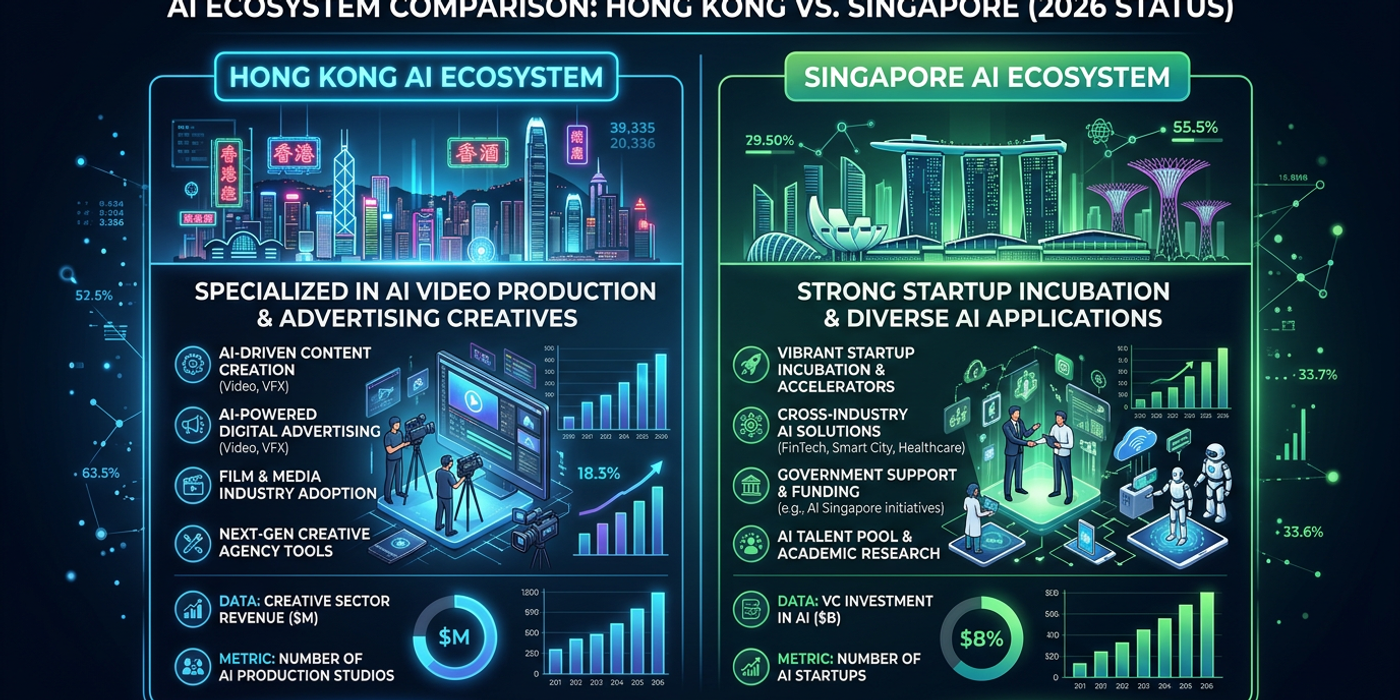
Hong Kong and Singapore took different AI adoption paths in 2026. We compare six key metrics — funding, government support, creator trends, and more.
Hong Kong and Singapore started 2026 running neck-and-neck on AI creative tool adoption. By September, the picture is more nuanced — each market has made distinct bets with distinct outcomes. Hong Kong's creative agencies dove headfirst into AI video production for advertising, while Singapore's ecosystem leaned toward startup incubation, AI R&D infrastructure, and enterprise-scale deployments. Neither path is wrong — but they serve different audiences.
Where Government Support Diverged
Hong Kong's CreateSmart initiative doubled down on AI video production grants this year, funnelling HKD $50 million into workshops, production subsidies, and cross-border collaborations with Shenzhen AI labs. The result? A measurable spike in AI-assisted commercial production across the advertising and real estate sectors — two industries where Hong Kong has traditionally dominated talent and infrastructure.
Singapore's Smart Nation 2.0 program took a different approach: direct grants to AI startups through the AI Verify Foundation and tax credits for companies building multimodal tools. The Monetary Authority of Singapore also launched a separate AI innovation fund targeting generative AI for financial services content — think AI-generated explainer videos, regulatory compliance documentation, and multilingual customer communications. The emphasis was on infrastructure and ecosystem building rather than direct production output.
Funding Flows: VC Bets Tell the Story
Venture capital tracked the government signals. Hong Kong saw most AI creative funding flow into advertising technology and short-form video production tools — companies building automated ad creatives for platforms like YouTube Shorts, Instagram Reels, and Douyin. The money went toward applied creativity rather than foundational research.
Singapore attracted heavier investment in AI infrastructure and developer tools. Startups building model orchestration platforms, API gateways, and custom fine-tuning services raised larger rounds. The difference reflects each market's natural strengths — Hong Kong as a content production hub, Singapore as a tech operations centre.
Creator Tool Preferences Reveal the Divide
The models and tools winning in each market tell a clear story. Hong Kong agencies gravitate toward video generation — Kling 3.0, Veo 3.1, Seedance 2.5, and FLUX 3 Video appear in production pipelines across the advertising and film sectors. The focus is on speed, cinematic quality, and batch video output for commercial campaigns.
Singapore creators, by contrast, show stronger adoption of image generation and text-to-speech tools. Nano Banana 2, FLUX Schnell, and ElevenLabs rank highly in usage surveys. The emphasis is on rapid prototyping, product imagery for e-commerce, and multilingual content — reflecting Singapore's role as a regional hub serving diverse language markets across Southeast Asia.
Talent Pipeline Differences
Hong Kong's proximity to the Greater Bay Area gives its agencies access to a deep pool of AI engineers and technical talent from Shenzhen and Guangzhou. This cross-border talent flow has accelerated Hong Kong's adoption of complex multi-model production workflows — pipelines that stitch together image gen, video gen, and audio gen in a single production pass.
Singapore's talent strategy relies on attracting regional and global AI researchers through its tech visa programs and university partnerships. The result is a stronger bench in AI research and product development — but a smaller pool of hands-on creative production talent compared to Hong Kong.
Cost Structures Favour Different Workflows
Studio rental costs in Hong Kong remain among the highest in Asia, creating strong economic incentives for agencies to adopt AI video production that reduces physical studio time. A single AI-generated commercial can eliminate 2-3 days of studio rental, lighting setup, and talent coordination.
Singapore's comparatively lower office and studio costs mean the cost-pressure incentive to adopt AI is weaker on the production side. Instead, the savings come from automation — automating repeated design tasks, client revisions, and multilingual content adaptation.
What the Metrics Say
Through September 2026, Hong Kong leads on AI video production volume per agency, with a 40% year-on-year increase in AI-assisted commercial projects. Singapore leads on AI tool diversity — creators in Singapore use an average of 2.3 more AI tools per project than their Hong Kong counterparts, reflecting broader experimentation across modalities.
The headline answer to "who adopts faster?" depends on how you measure adoption. Hong Kong adopts deeper — embedding AI into core production workflows. Singapore adopts broader — spreading AI usage across more tools and business functions. Both approaches generate real ROI, but for different creative objectives.
Frequently Asked Questions
Q: Which market has better government support for AI creativity? A: Hong Kong and Singapore offer different types of support. Hong Kong's CreateSmart scheme provides direct production subsidies for AI video. Singapore's Smart Nation 2.0 focuses on startup incubation and enterprise tax credits. The better option depends on whether you are a production house or a startup.
Q: Are Hong Kong agencies using different AI models than Singapore agencies? A: Yes. Hong Kong agencies prefer video generation models — Kling 3.0, Veo 3.1, and Seedance 2.5 lead usage. Singapore creators use more image generation tools like Nano Banana 2 and FLUX Schnell, plus text-to-speech tools.
Q: Does Hong Kong's cross-border access to Shenzhen talent affect AI adoption? A: Significantly. The proximity to Shenzhen's AI engineering talent gives Hong Kong agencies an advantage in building complex multi-model production pipelines that require technical integration skills.
Q: Why is AI video adoption higher in Hong Kong than Singapore? A: Hong Kong's high studio rental costs create a strong economic incentive to replace physical production with AI-generated video. Singapore's lower production costs reduce that specific cost pressure, though automation savings apply in both markets.
Q: Which market has more AI creative startups? A: Singapore has attracted more AI startup funding and incubator activity. Hong Kong's strength is in AI application within existing creative agencies rather than dedicated AI startups building new tools.
Q: How do creator tool preferences differ between HK and SG? A: Hong Kong creators focus on video tools for advertising and film production. Singapore creators diversify across image generation, voice synthesis, and multilingual content tools to serve regional markets.
Q: Is AI adoption in Hong Kong or Singapore growing faster? A: Both markets are growing rapidly but in different dimensions. Hong Kong's AI video production volume grew 40% year-on-year. Singapore's AI tool diversity — the number of different tools used per project — grew by a wider margin.
Q: What should a Hong Kong agency learn from Singapore's approach? A: Expanding into a wider range of AI modalities beyond video — image generation, voice synthesis, and multilingual tools — could open new service lines for Hong Kong agencies serving regional clients.