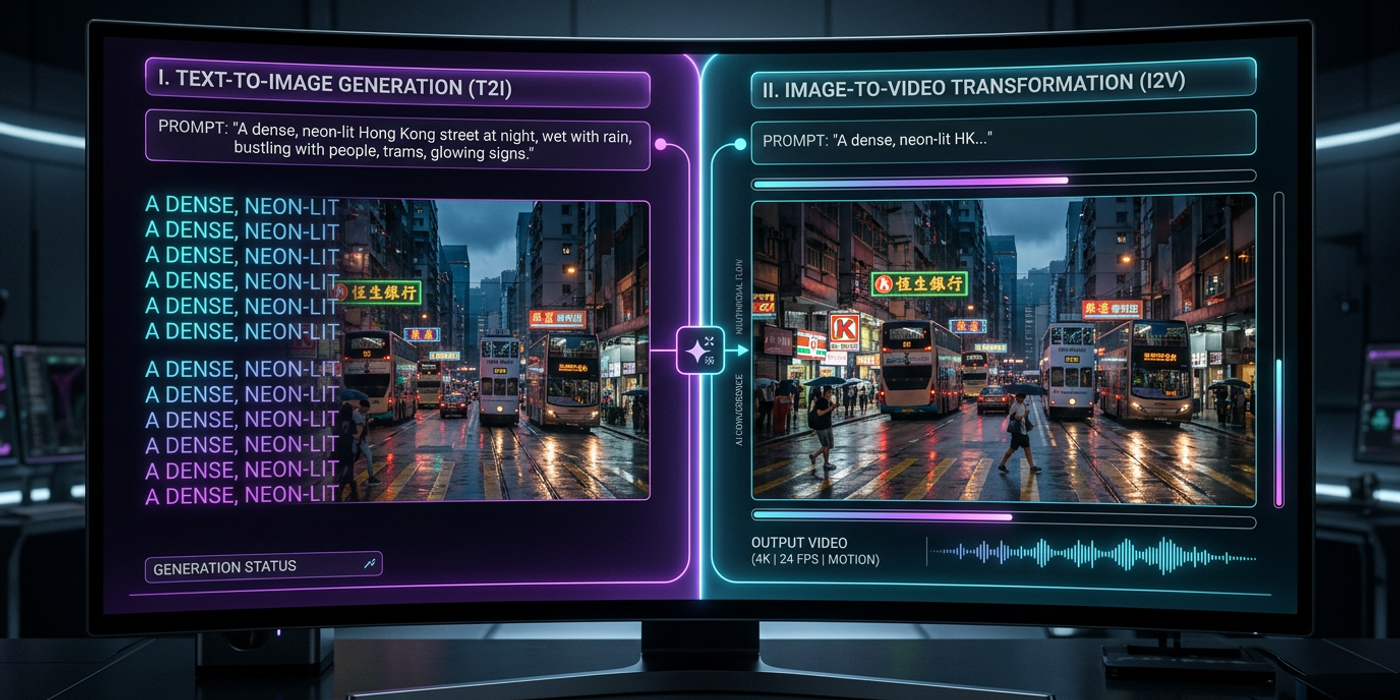
In 2026, multi-modal models broke down the wall between text-to-image and image-to-video generation. Here's what changed and how creators should adapt.
Until recently, the line between text-to-image (T2I) and image-to-video (I2V) was clear: T2I created stills from words, I2V animated those stills. In 2026, that line vanished. New multi-modal models generate images and video from the same interface, adapt outputs across formats, and even handle audio simultaneously. For Hong Kong creators, this convergence is not just a technical curiosity — it fundamentally changes how you plan and execute campaigns.
What Changed in 2026
The traditional pipeline — generate an image in Midjourney, feed it into Pika or Runway for animation, then layer sound in a separate tool — assumed each model could only do one thing. 2026 multi-modal models broke that assumption.
MiniMax H3, launched in August 2026, generates images, extends them to video, and outputs native stereo audio — all within a single model. Gemini Omni 1.1 Flash generates images from text prompts and accepts image inputs for video generation without switching models. Even open-weight models like FLUX 3 Video accept both text and image inputs, producing consistent outputs across formats.
The practical effect: you no longer need to choose between a T2I tool and an I2V tool. The model handles both, with shared understanding of style, composition, and motion.
Why the Old Pipeline No Longer Applies
Before multi-modal models, creators built pipelines: T2I, then I2V, then upscale, then edit. Each step risked breaking consistency. The character you generated in step one might shift subtly in step two. The lighting that looked perfect in the still might not carry into animation.
Multi-modal models solve this by treating image and video as the same latent space. When you prompt MiniMax H3 for a Hong Kong neon sign at night with cinematic lighting, the model understands that prompt as both a still image and the starting frame of a video. There is no translation loss between formats because there is no separate pipeline stage.
For HK agencies producing campaigns for HSBC, HKTB, or Lee Kum Kee, this means faster iteration. You can generate a brand-compliant still, decide it needs motion, and extend it — all without re-prompting or rebuilding the scene.
Which Models Are Leading the Convergence
Several late-2026 models exemplify the T2I and I2V convergence:
MiniMax H3 — Arguably the most complete multi-modal model. Generates images, video with native audio, and accepts both text and image inputs. The image-to-video extension is baked in rather than bolted on.
Gemini Omni 1.1 Flash — Google omni model handles T2I and I2V in the same inference pipeline. The 1.1 Flash update added 360p draft mode for rapid iteration and smarter scene extension.
FLUX 3 Video — Black Forest Labs video model accepts text prompts or reference images. The image input path produces video that maintains the reference composition and lighting, effectively collapsing T2I and I2V into one decision.
Seedance 2.5 — ByteDance model accepts image inputs for video generation with improved motion understanding. While it started as a pure I2V model, the 2.5 update significantly improved direct text-to-video quality.
How Hong Kong Creators Should Adapt
The convergence changes production strategy:
Plan for motion from the start. Since a single model can now generate images and extend them to video, compose prompts with camera motion, duration, and pacing in mind — even when you think you only need a still. The still becomes your starting frame, not your final output.
Reduce pipeline tools. Evaluate whether your current T2I to I2V workflow is adding value or complexity. If a single multi-modal model can handle both with better consistency, the multi-tool pipeline may be costing you quality.
Test across modalities. A prompt that generates a great image may produce mediocre video. Test your best-performing image prompts for video output, and vice versa. The multi-modal model shared latent space does not guarantee equal quality across formats.
Invest in prompt engineering that works for both. The most efficient approach in late 2026 is learning to prompt for image and video simultaneously. Include motion cues, duration preferences, and camera angles in your base prompts — even if you start with a still, you may want to extend it later.
Frequently Asked Questions
Q: Do I still need separate T2I and I2V tools? A: Not necessarily. Multi-modal models like MiniMax H3 and Gemini Omni 1.1 Flash handle both. Dedicated tools still offer specialized advantages in quality and control, but the gap is narrowing.
Q: Can multi-modal models match dedicated T2I or I2V quality? A: In most cases, yes. MiniMax H3 image quality competes with Midjourney, and FLUX 3 Video text-to-video quality matches dedicated I2V pipelines. The gap primarily exists in niche use cases like ultra-high resolution or specific animation styles.
Q: How does this affect my production budget? A: Using one model instead of two or three reduces API costs and iteration time. Multi-modal models also eliminate the quality loss between pipeline stages, reducing re-prompts.
Q: Do I need to change how I write prompts? A: Yes. Include motion, duration, and camera cues even when generating stills — they may become video later. Write prompts that work across formats.
Q: What about audio? Is it included? A: MiniMax H3 outputs native stereo audio with video. Most other multi-modal models handle image and video only. Audio remains a separate consideration for most workflows.
Q: Are there disadvantages to using one model for everything? A: Vendor lock-in is the main risk. If a model excels at both image and video today, a competitor may surpass it in one modality tomorrow. Maintain the ability to swap tools for specific outputs.
Q: How does this affect Hong Kong Cantonese content? A: Multi-modal models increasingly support Chinese prompts and cultural contexts. MiniMax H3 and Gemini handle Chinese inputs well, making them suitable for bilingual HK campaigns.
Q: What is the next milestone in multi-modal convergence? A: True real-time generation across all modalities with consistent quality. We are moving toward models that accept any input — text, image, video, audio — and output any format from the same interface.