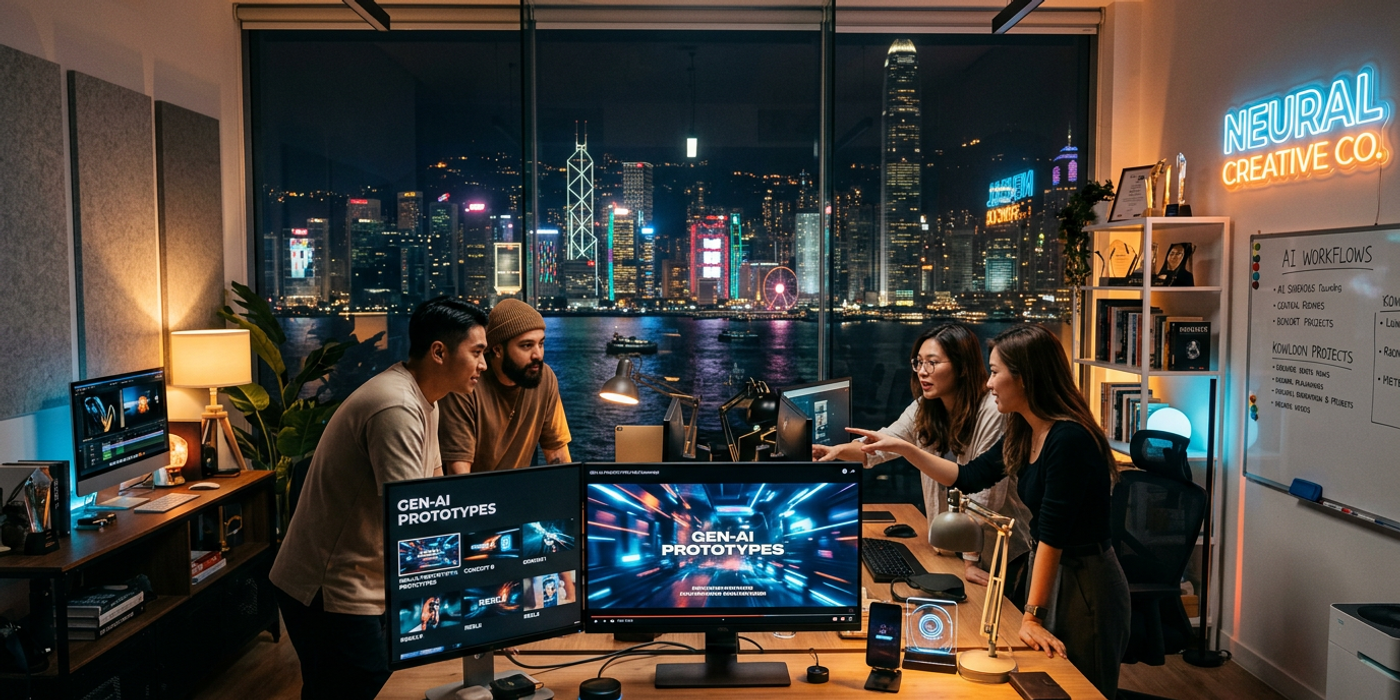
From pitch to final delivery, Hong Kong agencies integrate AI video at every stage. Here are 6 production-proven workflows driving results in 2026.
Hong Kong's advertising agencies moved past the “try AI video” phase months ago. In September 2026, the question isn't whether to use AI video — it's how to build reliable, repeatable production pipelines around it.
Early adopters who started with Veo 3.1 and Kling 3.0 back in May have now run hundreds of campaigns. They've learned what breaks, what saves money, and where AI still needs a human touch. The agencies winning pitches today aren't the ones with the best prompts — they're the ones with the tightest workflows.
Here are six production-proven AI video workflows that Hong Kong agencies are actually using in 2026, straight from the city's busiest creative shops.
1. Multi-model pipeline assembly
Top Hong Kong agencies assemble custom pipelines matching each production stage to the best model.
A typical pipeline: generate hero imagery with GPT-Image-2 or FLUX Schnell, animate through image-to-video with Veo 3.1 or Seedance 2.5, and use FLUX 3 Video or Wan3.0 for longer sequences.
Veo 3.1 handles cinematic camera movement best, but Kling 3.0 is faster for social batches. Agencies that hardwire one model lose flexibility; model-agnostic workflows deliver better results.
Cooly Studio supports this approach natively by letting you switch between models without rebuilding your project. One creative director we spoke to described it as “having a full production house in a single browser tab.”
2. Quality control gates with rejection budgets
Not every AI generation is usable. Early-stage rejection rates of 60-80% are normal; mature pipelines hover around 40-50%.
Profitable agencies build quality control gates at three stages:
Stage 1 — Prompt screening. Before generating a single frame, the creative team reviews prompts against a brand brief and a model capability checklist. “Can Veo 3.1 handle this camera movement?” “Will Seedance 2.5 preserve this product texture?” If the answer is no, adjust the prompt or switch models before burning credits.
Stage 2 — Batch generation. Run 5-10 variations simultaneously, not sequentially. This collapses the iteration cycle from hours to minutes. Pick the best 1-2 from each batch and discard the rest.
Stage 3 — Client preview. Send compressed, watermarked drafts — never the full-resolution renders. Only render final quality after client approval. This alone cuts compute costs by 50-70%.
One Causeway Bay agency cut their effective rejection rate from 75% to 35% — saving roughly HK$40,000 per campaign.
3. Reference-image consistency loops
Luxury and hospitality agencies have the strictest consistency demands: the same product, talent, and lighting across every scene.
Reference-image workflows make this possible:
1. Shoot or generate a “brand anchor” image — one frame that defines the look, lighting, and composition 2. Use this anchor as the reference input for image-to-video generation in Veo 3.1, Seedance 2.5, or FLUX 3 Video 3. Review each generation against the anchor. If the model drifts, adjust the reference crop or regenerate 4. Build a library of approved anchors for each brand, reused across campaigns
4. Cantonese-first production pipelines
Hong Kong agencies face a problem global competitors don't: AI video tools are English-first. Generating Cantonese content requires deliberate design.
The most effective approach splits audio and video production. Generate visuals in any AI video tool, then layer Cantonese audio using Gradium TTS or Cartesia Sonic-3.6, both now supporting Cantonese with natural prosody.
For bilingual campaigns, the pipeline adds AI-generated subtitle timing and voiceover alignment. Cooly Studio's multi-track timeline handles this without exporting between tools.
Agencies deliver fully localised Cantonese campaigns in two days instead of two weeks.
5. Client approval loops with version trees
Agencies that treat AI video like traditional production lose the speed advantage.
The agencies making AI profitable run parallel approval loops. They generate 3-5 distinct versions of the same brief and present them simultaneously. The client picks one or combines elements from several, and the agency refines only the chosen direction.
Version trees keep this manageable. Each brief spawns a tree of variations; the client sees top-level branches while the agency manages sub-branches internally.
One senior producer at a Wong Chuk Hang agency described it as “pitching three finished commercials instead of one storyboard.” The pitch win rate? Up 40% since they switched to this model.
6. Post-production integration standards
The final workflow connects AI generation to traditional post-production. Treating AI clips as “final assets” causes colour, frame rate, and boundary issues.
The solution is standardisation. Successful agencies define output specifications before generating:
- Frame rate: 24fps or 30fps (no mixing within a campaign) - Resolution: match the target platform (1080p for social, 4K for broadcast) - Colour space: Rec.709 as default, with LUT application in post - Clip length: standardise at 5, 10, or 15 seconds for easy compositing
Agencies that enforce these standards spend 80% less time on post-production fixes. AI clips drop directly into the timeline.
Frequently Asked Questions
Q: Which AI video model is best for Hong Kong agency work in 2026? A: No single model. Veo 3.1 leads for cinematic quality, Kling 3.0 for speed, FLUX 3 Video for longer clips, and Wan3.0 for document-to-video. Most agencies use 2-3 interchangeably.
Q: How many AI generations does a typical commercial need? A: 50-100 per 30-second spot, with 35-50% acceptance after quality gates.
Q: Can AI video replace traditional production? A: Not yet, but AI handles the middle tier — social media content, product demos, and pitch reels — where speed and cost matter most.
Q: How do Hong Kong agencies handle Cantonese AI video production? A: Most split the process: generate visuals in any AI video tool, then layer Cantonese voiceover using TTS models like Gradium TTS or Cartesia Sonic-3.6. Cooly Studio's multi-track timeline keeps everything in one place.
Q: What's the biggest mistake agencies make with AI video? A: Treating every generation as a final asset. Successful agencies set output standards before generating and build quality gates to filter unusable clips early.
Q: How much do Hong Kong agencies save with AI video pipelines? A: 50-80% on production costs for social media content, pitch reels, and product demos. One mid-sized agency redirected HK$500,000 in annual savings into creative strategy and talent.
Q: What's the emerging job role in AI video production? A: The “AI producer” — a hybrid role combining creative direction, prompt engineering, model selection, and post-production knowledge. Agencies hiring these roles are outperforming those that split the work across traditional teams.
Q: How do agencies prevent brand inconsistency? A: Reference-image workflows with approved brand anchors. One consistent frame guides every generation.