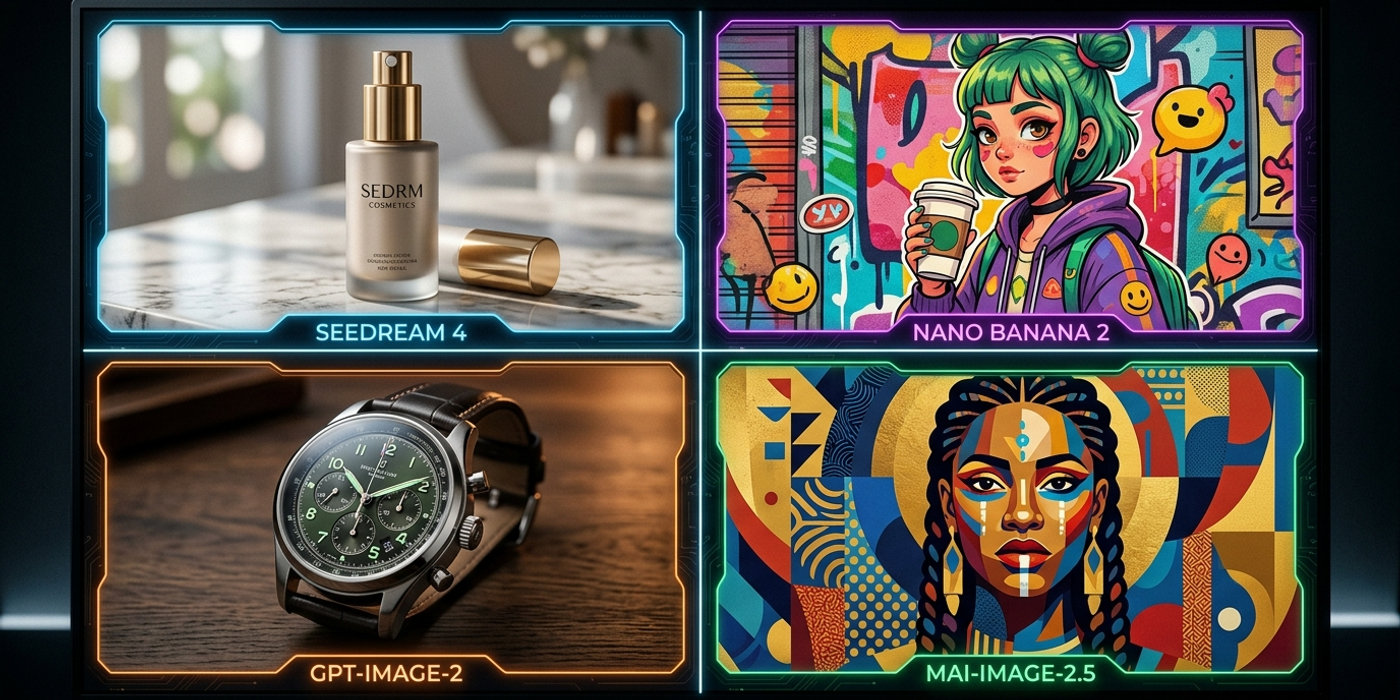
Seedream 4 vs Nano Banana 2 dominated mid-2026 image AI. Now MAI-Image-2.5, GPT-Image-2, and Imagine 2.0 enter. How should HK creators choose?
Seedream 4 vs Nano Banana 2 in Late 2026: Image AI Landscape Widens
If you asked any AI creator in June 2026 which image generation model to use, the answer was almost always Seedream 4 or Nano Banana 2. These two had established a clear duopoly — Seedream 4 from ByteDance for photorealistic quality, Nano Banana 2 from Recraft for designer-friendly control and style variety.
Fast-forward to September 2026 and the picture has changed dramatically. Three serious challengers have entered: Microsoft MAI-Image-2.5, OpenAI GPT-Image-2, and xAI Imagine 2.0. Each brings distinct strengths — MAI-Image-2.5 matches Nano Banana 2 at comparable pricing, GPT-Image-2 integrates deep language understanding, and Imagine 2.0 introduces a state-of-the-art editing workflow.
For Hong Kong creators who need to pick one model for their production pipeline, the choice is no longer binary. This article breaks down where each model excels and how to make the right call for your specific use case.
How the Image AI Landscape Shifted Since Mid-2026
The emergence of new image generation models since August 2026 has reshaped the competitive landscape in three important ways.
First, Microsoft MAI-Image-2.5 eliminated the budget premium gap. Before August, Nano Banana 2 was the clear winner for high quality at reasonable API pricing. MAI-Image-2.5 matched it on visual quality across MJHQ-30K and T2I-CompBench metrics while exceeding it on prompt adherence. For Hong Kong brands producing e-commerce imagery at scale, this creates a genuine alternative.
Second, GPT-Image-2 from OpenAI introduced a fundamentally different approach to prompt fidelity. Unlike diffusion models that require carefully structured prompt syntax, GPT-Image-2 treats text as native input. It understands complex scene descriptions, spatial relationships, and stylistic references with remarkable accuracy. This is a meaningful advantage for creators who struggle with prompt engineering.
Third, xAI Imagine 2.0 raised the bar on iterative editing. Its in-place editing workflow — select a region, describe the change, and watch the model apply it while preserving the rest of the image — has become the standard others are racing to match. For advertising agencies producing comps and storyboards, this speed improvement alone justifies consideration.
Meanwhile, both Seedream 4 and Nano Banana 2 have received incremental updates. ByteDance improved Seedream 4's text rendering and expanded Chinese language support. Recraft added integrations with Figma and Adobe Creative Cloud, tightening Nano Banana 2's position as the designer's choice.
Choosing the Right Model for Your Hong Kong Workflow
The widening field means the old advice no longer applies. Different use cases call for different models, and the smartest approach is running two or three models side by side.
For brand advertising and product photography, Seedream 4 remains the strongest choice. Its photorealistic output is unmatched for luxury goods, food photography, and high-end retail visuals. The model handles fine details — fabric texture, product reflections, packaging typography — with consistent accuracy. If your client is a fashion label or a premium F&B brand, Seedream 4 should be your primary model.
For social media content and iterative campaign testing, Nano Banana 2 with its Creative Cloud integration offers the fastest workflow. The model generates multiple stylistic variations for A/B testing across Meta, Google, and Douyin campaigns. The recently added batch mode generates 16 variations from a single prompt — a feature no challenger has matched yet.
For prompt-complex projects and experimental creative work, GPT-Image-2 is the most interesting new option. Its ability to understand intricate prompts with multiple subjects makes it ideal for conceptual advertising and complex product scenarios. If your brief says "a red teapot on a wooden table with steam curling to the left in Chinese ink painting style," GPT-Image-2 delivers closer than any other model.
For cost-sensitive production pipelines, MAI-Image-2.5 is the most compelling new entrant. Its prompt adherence — frequently topping the T2I-CompBench leaderboard — means fewer retries and lower overall costs. For agencies running hundreds of product images per week, this translates to improved margins.
For editing-heavy workflows, xAI Imagine 2.0 is the specialist pick. Its selective editing capabilities reduce the need for manual Photoshop work, saving significant time for post-production teams.
What This Means for Hong Kong's Creative Industry
Hong Kong's AI adoption has always been pragmatic — agencies here care about what works. The widening of the image AI field drives pricing competition and capability differentiation.
The practical takeaway: most Hong Kong agencies should maintain a multi-model strategy. Keep Seedream 4 for high-end brand work, use Nano Banana 2 or MAI-Image-2.5 for volume production, and add GPT-Image-2 or xAI Imagine 2.0 for projects needing complex prompt understanding or intensive editing.
The era of standardising on one image model across all client work is over. The winners will be agencies that route each project to the model that fits it best.
Frequently Asked Questions
Q: Is Nano Banana 2 still worth using now that MAI-Image-2.5 exists? A: Yes. Nano Banana 2 offers more artistic styles and tighter design tool integration. MAI-Image-2.5 is better for prompt adherence and cost-efficient volume production.
Q: Can GPT-Image-2 replace Seedream 4 for product photography? A: Not yet. Seedream 4 produces more photorealistic output for e-commerce and luxury shots. GPT-Image-2 is better for creative concepts and editorial work.
Q: Which model works best for bilingual English-Chinese content? A: Seedream 4 has the strongest Chinese text rendering, making it the top choice for bilingual campaigns. GPT-Image-2 handles bilingual prompts well but text rendering is less reliable.
Q: Should I use one model for everything or switch between models? A: A multi-model strategy is now standard. Route product photography to Seedream 4, volume social media to MAI-Image-2.5 or Nano Banana 2, and creative briefs to GPT-Image-2.
Q: Does xAI Imagine 2.0 have an API for production use? A: Yes, xAI offers API access at competitive rates with editing features available programmatically for automated post-production pipelines.
Q: How does prompt engineering differ across these models? A: GPT-Image-2 understands natural language best with minimal structuring. Seedream 4 and Nano Banana 2 benefit from detailed negative prompts. MAI-Image-2.5 excels with short direct prompts.
Q: Which model handles the fastest generation speed? A: Nano Banana 2 produces results in 2-4 seconds, making it the fastest for previews. MAI-Image-2.5 averages 4-8 seconds. Seedream 4 and Imagine 2.0 take 8-15 seconds for higher-resolution outputs.
Q: What's the most affordable option for volume production? A: MAI-Image-2.5 and Nano Banana 2 are the most affordable at roughly $0.02-0.04 per standard generation for volume API users.