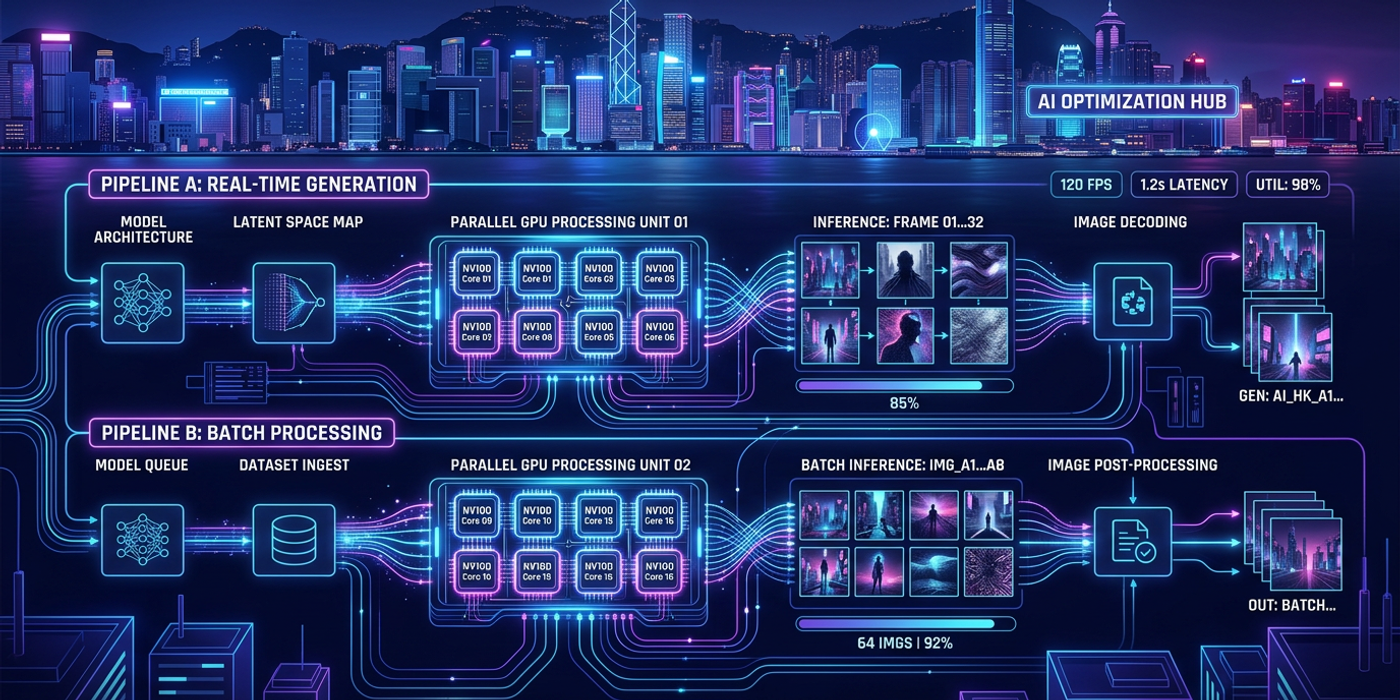
Batch smarter, parallelize API keys, and pipeline post-production steps — learn how Hong Kong agencies cut AI image generation time by 60-80% in 2026.
Speed-Optimized AI Image Workflows in 2026: Batch, Parallel & Pipeline Strategies
Faster AI image generation is about more than picking the fastest model — it's about designing a workflow that eliminates idle time, batches intelligently, and pipelines multiple steps in parallel. In late 2026, Hong Kong agencies running high-volume production can cut per-image generation time by 60-80% without touching model quality. Here is how.
Batch Generation Strategies That Actually Save Time
Batch generation — submitting multiple prompts in a single API call — sounds simple, but most teams leave significant speed on the table. The key insight is that batch size interacts with model architecture differently across providers.
GPT-Image-2 batches 4-6 images in roughly the same time as generating one (about 8-12 seconds per batch), making small batches the most efficient choice. FLUX Schnell, by contrast, scales almost linearly with batch count — generating 8 images takes about twice as long as 4 — so the sweet spot is 2-3 images per batch to maintain its speed advantage. Nano Banana 2 handles variable batch sizes well up to 8 images, but queues can fill unpredictably during HK business hours (10 AM-4 PM HKT), so pre-batching overnight yields reliably fast returns by morning.
The practical takeaway: match your batch strategy to the model, not the other way around. For mixed-model workflows — generating hero images on GPT-Image-2 and variants on FLUX Schnell — split batches by model rather than combining them in a single queue.
Parallel Processing Across Multiple API Keys
The most underused speed lever in 2026 is parallel API key deployment. Running multiple API keys simultaneously — spread across different model endpoints or the same model with load-balanced keys — can multiply throughput without requiring a faster model.
For agencies handling 50+ images per project, a simple three-key rotation on GPT-Image-2 delivers roughly 3x throughput over single-key usage during off-peak hours. The caveat: rate limits and concurrency caps differ. Nano Banana 2 allows up to 5 concurrent requests per key; FLUX Schnell allows 3. Going beyond these triggers 429 errors that waste more time than they save.
The smart setup for HK agencies is a key pool that rotates automatically — assign one key per generation lane (product shots, social variants, editorial images) so no single lane blocks others. Tools like Cooly.ai's API dashboard make this visible at a glance, showing per-key throughput and error rates in real time.
Pipeline Architecture for End-to-End Speed
The biggest hidden time cost is not generation itself — it's the hand-offs between steps. A typical production pipeline — generate image, upscale, remove background, composite into template — can lose 60 seconds just in middle steps if each runs sequentially.
Pipeline parallelism changes this. Modern approaches chain post-processing steps asynchronously: while image A is upscaling, image B is generating, and image C is being composited. This requires a queue system that tracks dependency ordering — something the best AI workflow tools now handle natively.
For Hong Kong brands producing consistent product photography, a parallel pipeline that overlaps generation with post-production cuts total project time from about 90 minutes to 25 minutes for a 30-image catalog. The models themselves haven't changed speed — the architecture did.
Model Selection for Speed in Late 2026
The speed leaderboard has shifted since mid-year. FLUX Schnell remains the fastest per-image model at roughly 1.5 seconds per 1024x1024 image on standard settings, but GPT-Image-2's new turbo mode (available since August) closes the gap to about 2 seconds with noticeably better compositional accuracy. Nano Banana 2 sits at 3-4 seconds per image but produces the most reliable results for complex prompts that require multiple revisions.
The real optimization is not picking the single fastest model — it's matching model speed to usage context. For social media A/B testing where you generate 40 variants and keep 2, FLUX Schnell's speed advantage saves real time. For client-facing hero images that need zero corrections, the extra 2 seconds on GPT-Image-2 or Nano Banana 2 pays for itself by eliminating re-generation cycles.
Seedream 4, at roughly 5-6 seconds per image, is the slowest of the current generation but produces the highest detail ceiling. Use it sparingly — only for the lead image in a set, not for bulk production.
Queue Management During Peak HK Hours
Hong Kong agencies face a structural speed problem: peak generation hours (10 AM to 4 PM HKT) overlap with peak API usage across Asia, creating 15-30 second queue waits even on paid plans. The fix is time-shifting — running heavy batch jobs overnight or scheduling them for early morning (6-9 AM HKT) when regional API traffic is lowest.
For same-day turnaround projects, maintain a small always-on queue for priority images and a separate bulk queue for variants. This prevents a 50-image batch from delaying the one image your client is waiting on. Most API dashboards now support priority tagging — use it.
Frequently Asked Questions
Q: What is the fastest AI image model in late 2026? A: FLUX Schnell leads at roughly 1.5 seconds per 1024x1024 image, with GPT-Image-2 turbo mode close behind at about 2 seconds.
Q: How much faster is batch generation compared to individual requests? A: Depending on the model, batch generation saves 40-70% of total time — GPT-Image-2 batches 4-6 images in the same time as one.
Q: Can I use multiple API keys to speed up generation? A: Yes — a three-key rotation can roughly triple throughput, but respect each model's concurrency limits to avoid rate-limit errors.
Q: Does Nano Banana 2 support parallel requests? A: Yes, up to 5 concurrent requests per key, but queue delays during HK business hours make pre-batching overnight a better strategy.
Q: What is pipeline parallelism in AI image workflows? A: Running post-processing steps (upscaling, background removal, compositing) in parallel with active generation instead of sequentially.
Q: How much time can pipeline parallelism save? A: For a 30-image product catalog shoot, parallel pipelining cuts total turnaround from ~90 minutes to ~25 minutes.
Q: When is the best time to run bulk AI image generation in Hong Kong? A: Off-peak hours (6-9 AM HKT or overnight) avoid Asian peak API traffic and cut queue wait times by 15-30 seconds per image.
Q: Should I always use the fastest model for every image? A: No — match speed to usage. Use FLUX Schnell for high-volume A/B testing, GPT-Image-2 or Nano Banana 2 for client-facing work, and Seedream 4 only for hero images.