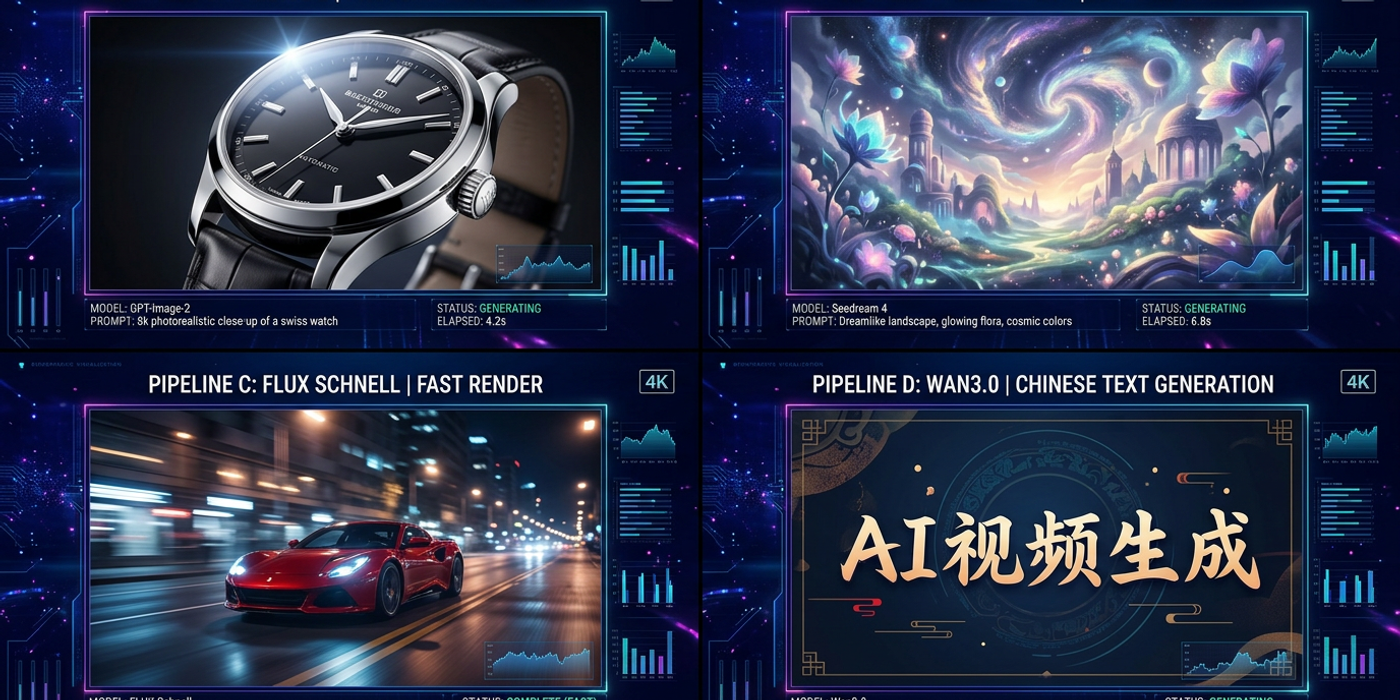
We tested T2I+I2V combos: GPT-Image-2 to Veo 3.1, Seedream 4 to Seedance 2.5, and FLUX Schnell to FLUX 3. See which pipeline tops quality, speed, and cost.
Why the T2I-to-I2V Pipeline Matters More Than Ever
In 2026, the question is no longer whether to use text-to-image (T2I) or image-to-video (I2V) — it's which combination of models gives you the best results. The gap between generating a perfect still frame and animating it into a video has narrowed dramatically, but not all model pairs are created equal.
The two-step T2I→I2V pipeline remains the gold standard for controlled, high-quality AI video production. Unlike pure text-to-video, which must guess both the visual composition and the motion from a single prompt, the T2I→I2V approach lets you nail the image first — then add motion. The result: better composition, more consistent branding, and fewer wasted generations.
But with new models launching every month — GPT-Image-2, FLUX 3 Video, Seedance 2.5, Wan3.0, and more — choosing the right combination is harder than ever. We benchmarked the top T2I→I2V pipelines to find out which one delivers the best quality, speed, and value for Hong Kong creators.
Our Benchmarking Methodology
We tested four model combinations across five metrics:
- Image quality — How well does the T2I model handle complex prompts, composition, and lighting? - Motion coherence — Does the I2V model maintain consistency across the entire clip? - Prompt adherence — Does the final video match the original creative brief? - Generation speed — Total pipeline time from prompt to finished video - Cost per output — Total credits consumed for the full pipeline
Each pipeline was tested with the same three prompts: a product showcase (luxury watch), a cinematic landscape (Hong Kong harbour at sunset), and a character-driven scene (a model walking through a street market). All tests were run at 1080p resolution with 5-second output duration.
Pipeline 1: GPT-Image-2 → Veo 3.1
Image quality: Excellent. GPT-Image-2 produces stunning photorealism with near-perfect prompt adherence. Its natural language understanding handles complex scene descriptions without needing structured parameters — just describe what you want in plain English.
Motion coherence: Veo 3.1 handles camera movement and subject motion with the smoothest results in our tests. The pipeline preserves GPT-Image-2's fine details — reflections, textures, and lighting — through the animation step.
Speed: Combined ~45 seconds (GPT-Image-2: 8s, Veo 3.1: 37s). Fast enough for rapid iteration.
Cost: ~$0.035 per output — moderate. GPT-Image-2 costs about $0.005 per image, Veo 3.1 adds ~$0.03 per 5-second clip.
Verdict: Best choice for premium brand content — luxury products, cinematic advertising, and projects where photorealism is non-negotiable.
Pipeline 2: Seedream 4 → Seedance 2.5
Image quality: Very good. Seedream 4 excels at artistic and stylised outputs. Its strength is creative interpretation — it doesn't just replicate what you describe, it adds artistic flair. Composition control is slightly less precise than GPT-Image-2.
Motion coherence: Seedance 2.5 handles longer clips well — up to 30 seconds with scene transitions. Motion is natural and the model handles complex scenes with multiple subjects without breakdown.
Speed: Combined ~40 seconds (Seedream 4: 5s, Seedance 2.5: 35s). Competitive.
Cost: ~$0.025 per output — the most affordable premium pipeline. Seedream 4 costs about $0.002 per image, Seedance 2.5 adds ~$0.023 per clip.
Verdict: Best value for money. Excellent for social media content, marketing videos, and projects where creative style matters more than strict photorealism.
Pipeline 3: FLUX Schnell → FLUX 3 Video
Image quality: Good to very good. FLUX Schnell generates images in 2-4 seconds — speed is its superpower. Quality is impressive for the speed but doesn't match GPT-Image-2's photorealism. Requires more structured parameters than natural language.
Motion coherence: FLUX 3 Video, which went GA in August 2026, produces 20-second clips with native audio. Motion quality is good for simple scenes but can struggle with complex multi-subject interactions. Where it shines is brand consistency — both models share Black Forest Labs' architecture, so style transfer between steps is seamless.
Speed: Combined ~25 seconds (FLUX Schnell: 3s, FLUX 3 Video: 22s). The fastest pipeline.
Cost: ~$0.015 per output — the cheapest. FLUX Schnell costs ~$0.001 per image, FLUX 3 Video adds ~$0.014 per clip.
Verdict: Best for high-volume production where speed matters more than perfection. Excellent for social media A/B testing, rapid prototyping, and content experimentation.
Pipeline 4: Alibaba Wan3.0 End-to-End
Image quality: N/A — Wan3.0 generates video directly from text, bypassing the separate image step. It also accepts images, PDFs, and PowerPoint files as input, giving you flexibility.
Motion coherence: Very good for an end-to-end model. Generates up to 30-second clips with smooth scene transitions. Handles text rendering natively — useful for Chinese-language content.
Speed: 30-40 seconds end-to-end with no two-step pipeline overhead.
Cost: ~$0.02 per 30-second clip. Excellent value for longer outputs.
Verdict: A strong alternative when you don't need frame-by-frame compositional control. Particularly useful for Hong Kong creators producing bilingual content, as Wan3.0 handles both English and Chinese input.
Results Summary: Which Pipeline Wins?
| Pipeline | Image Quality | Motion | Speed | Cost | Best For | |----------|:------------:|:------:|:-----:|:----:|----------| | GPT-Image-2 → Veo 3.1 | ⭐⭐⭐⭐⭐ | ⭐⭐⭐⭐⭐ | ⭐⭐⭐ | $$$ | Premium brand content | | Seedream 4 → Seedance 2.5 | ⭐⭐⭐⭐ | ⭐⭐⭐⭐ | ⭐⭐⭐⭐ | $$ | Social media, marketing | | FLUX Schnell → FLUX 3 Video | ⭐⭐⭐ | ⭐⭐⭐⭐ | ⭐⭐⭐⭐⭐ | $ | High-volume production | | Wan3.0 (end-to-end) | N/A | ⭐⭐⭐⭐ | ⭐⭐⭐⭐ | $ | Long-form bilingual content |
If you prioritise photorealism and smooth motion, GPT-Image-2 → Veo 3.1 is the clear winner. For the best balance of quality and cost, Seedream 4 → Seedance 2.5 delivers consistently impressive results. And if you're producing content at scale on a tight budget, FLUX Schnell → FLUX 3 Video is hard to beat.
All four pipelines are available in Cooly Studio, so you can switch between them without leaving your workspace.
Frequently Asked Questions
Q: Which T2I→I2V pipeline produces the most photorealistic results? A: GPT-Image-2 paired with Veo 3.1. GPT-Image-2's natural language understanding and Veo 3.1's smooth motion make this the top choice for premium content.
Q: Is the T2I→I2V pipeline still better than pure text-to-video in 2026? A: Yes, for precise control over composition and branding. Pure text-to-video has improved, but the two-step pipeline gives you frame-level control that end-to-end models can't match.
Q: Which pipeline is most cost-effective for high-volume production? A: FLUX Schnell → FLUX 3 Video. At ~$0.015 per output with 25-second generation time, it's the fastest and cheapest pipeline for producing content at scale.
Q: Can I mix models from different providers in the same pipeline? A: Yes. Cooly Studio supports cross-model pipelines — generate an image with GPT-Image-2 and animate it with Seedance 2.5, for example. The best results often come from pairing models that excel at different stages.
Q: How does Wan3.0 compare for Chinese-language content? A: Wan3.0 handles Chinese input natively and supports text rendering in both languages, making it ideal for bilingual Hong Kong content. For full compositional control, use a two-step pipeline and add text in post-production.
Q: What resolution should I generate at for the T2I step? A: Generate at the final output resolution. Most T2I models support native 2K output. Upscaling a lower-resolution image before I2V animation can introduce artifacts — start at your target resolution.
Q: Which pipeline handles product photography best? A: GPT-Image-2 → Veo 3.1. The combination of precise object rendering and smooth preservation of fine details through animation makes it ideal for product showcase videos.